Blog
What Is E-Logistics? Why It Is Essential for Modern Transportation Management in the AI Era
Key Takeaways
- E-logistics digitizes transportation operations, improving visibility, efficiency, and supply chain coordination.
- AI, automation, and real-time tracking help businesses optimize routes, reduce costs, and enhance delivery performance.
- Modern Transportation Management Systems (TMS) are essential for managing increasingly complex logistics networks.
- Data-driven insights and predictive analytics enable smarter decision-making and more resilient transportation operations.
- Platforms like nuVizz help organizations unify planning, execution, visibility, and last-mile delivery in a single, scalable solution.
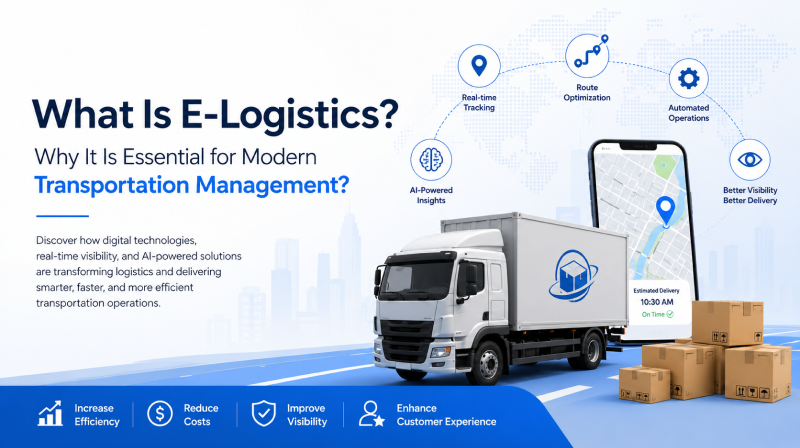
Table of Contents
The logistics industry has undergone a remarkable transformation over the past decade. The rapid growth of e-commerce, rising customer expectations for same-day and next-day deliveries, global supply chain disruptions, and advances in digital technologies have fundamentally changed how goods move from manufacturers to customers.
Today, transportation management is no longer just about moving products from one location to another. It is about delivering speed, visibility, efficiency, flexibility, and exceptional customer experiences. This shift has given rise to e-logistics—a technology-driven approach that digitizes and optimizes logistics operations across the entire supply chain.
Organizations that embrace e-logistics can streamline transportation planning, improve delivery performance, gain real-time visibility into shipments, and make data-driven decisions that reduce costs while improving customer satisfaction.
In this blog, we’ll explore what e-logistics is, why it has become essential for modern transportation management, the technologies that power it, and how organizations can leverage intelligent transportation platforms to build more resilient and efficient logistics operations.
What Is E-Logistics?
E-logistics, or electronic logistics, refers to the use of digital technologies, cloud platforms, automation, artificial intelligence (AI), and connected systems to plan, execute, monitor, and optimize logistics and transportation operations.
Unlike traditional logistics, which often relies on manual coordination and disconnected systems, e-logistics integrates every stage of the logistics lifecycle into a connected digital ecosystem.
An effective e-logistics strategy enables organizations to:
- Digitize transportation planning
- Optimize route planning and dispatch
- Track shipments in real time
- Automate customer communications
- Improve fleet utilization
- Manage reverse logistics efficiently
- Analyze operational performance using data and AI
Simply put, e-logistics transforms logistics from a reactive process into a proactive, intelligent operation.
Traditional Logistics vs. E-Logistics
| Traditional Logistics | E-Logistics |
| Manual planning | Automated planning |
| Limited shipment visibility | Real-time visibility |
| Static routes | Dynamic route optimization |
| Paper-based documentation | Digital workflows |
| Reactive issue resolution | Predictive decision-making |
| Siloed systems | Connected platforms |
| Limited analytics | AI-powered insights |
As customer expectations continue to evolve, organizations increasingly require digital logistics capabilities to remain competitive.
Why E-Logistics Is Essential for Modern Transportation Management
Transportation management has become significantly more complex than it was even five years ago.
Organizations must coordinate multiple carriers, warehouses, fulfillment centers, suppliers, drivers, and customers while maintaining high service levels and controlling transportation costs.
E-logistics provides the technology foundation needed to manage this complexity.
1. Real-Time Visibility
Visibility is one of the most valuable capabilities in modern logistics.
With GPS tracking, IoT devices, and cloud-based transportation platforms, businesses can monitor shipments throughout the delivery journey, identify disruptions early, and communicate accurate ETAs to customers.
This improves operational control while reducing customer inquiries.
2. Faster and Smarter Route Optimization
Traditional route planning often relies on static schedules.
Modern e-logistics platforms use AI-powered optimization that considers traffic conditions, delivery priorities, vehicle capacity, customer time windows, and driver availability to generate more efficient routes.
The result is:
- Reduced fuel consumption
- Lower transportation costs
- Improved delivery productivity
- Better on-time performance
3. Enhanced Customer Experience
Today’s customers expect complete transparency throughout the delivery process.
E-logistics enables organizations to provide:
- Live shipment tracking
- Automated delivery notifications
- Accurate ETAs
- Digital proof of delivery
- Easy returns and reverse logistics
These capabilities improve customer trust while reducing support costs.
4. Better Decision-Making Through Data
Modern transportation generates enormous volumes of operational data.
E-logistics platforms transform this information into actionable insights by measuring:
- On-time delivery performance
- Fleet utilization
- Delivery costs
- Driver productivity
- Carrier performance
- Customer satisfaction
These insights help organizations continuously improve transportation operations.
5. Greater Scalability
As businesses grow, manual logistics processes become increasingly difficult to manage.
E-logistics enables organizations to scale transportation operations across multiple regions, warehouses, carriers, and delivery networks without significantly increasing operational complexity.
Compare nuVizz, Bringg, and Onfleet to choose the best last-mile tracking software for your business.
See the ComparisonCore Technologies That Power E-Logistics
Modern e-logistics relies on a combination of advanced digital technologies.
1. Transportation Management Systems (TMS)
A Transportation Management System serves as the operational backbone for planning, executing, monitoring, and optimizing transportation activities.
A modern TMS helps organizations automate dispatch, optimize routes, manage carriers, improve shipment visibility, and analyze transportation performance.
2. Artificial Intelligence
AI has become a critical driver of logistics innovation.
Organizations now use AI for:
- Predictive ETAs
- Intelligent dispatching
- Demand forecasting
- Capacity planning
- Delivery optimization
- Exception management
AI enables transportation teams to make faster and more informed decisions.
3. Internet of Things (IoT)
Connected sensors and telematics provide continuous visibility into vehicle locations, shipment conditions, and fleet health.
This information improves operational reliability and proactive maintenance.
4. Cloud Computing
Cloud-based logistics platforms allow teams across locations to collaborate in real time while integrating seamlessly with enterprise systems such as ERP, WMS, and OMS.
5. Automation
Automation reduces repetitive manual tasks including:
- Order allocation
- Dispatch scheduling
- Customer notifications
- Electronic proof of delivery
- Invoice reconciliation
- Reporting
This allows logistics teams to focus on strategic decision-making.
Common Challenges in E-Logistics
Despite its advantages, implementing e-logistics comes with challenges.
Organizations often face:
- Fragmented technology ecosystems
- Rising transportation costs
- Driver shortages
- Increasing customer expectations
- Delivery delays
- Limited supply chain visibility
- Complex reverse logistics
- Data integration issues
Addressing these challenges requires a unified transportation strategy supported by intelligent digital platforms.
The Future of E-Logistics
The next generation of transportation management will be increasingly intelligent, automated, and predictive.
Key trends shaping the future include:
- AI-powered logistics assistants
- Predictive transportation planning
- Autonomous delivery technologies
- Hyperautomation across logistics workflows
- Digital twins for transportation networks
- Sustainable fleet optimization
- Carbon emissions tracking
- Advanced transportation analytics
- Machine learning-driven route optimization
Organizations investing in these capabilities today will be better positioned to adapt to changing market demands and customer expectations.
Compare the best route planning software to reduce fuel costs, optimize routes, and boost fleet efficiency. Explore the Top 5How nuVizz Helps Businesses Modernize E-Logistics
As transportation networks become more dynamic and customer expectations continue to rise, organizations need more than standalone logistics tools. They need a connected platform that unifies planning, execution, visibility, and optimization across the delivery lifecycle.
nuVizz provides an AI-powered transportation and last-mile delivery platform designed to help retailers, manufacturers, distributors, healthcare providers, and logistics service providers streamline operations while delivering exceptional customer experiences.
The platform enables organizations to manage transportation more intelligently through capabilities such as:
- AI-powered route optimization and dynamic dispatch
- Real-time shipment visibility and tracking
- Electronic proof of delivery (ePOD)
- Automated customer notifications and live delivery updates
- Last-mile delivery orchestration
- Reverse logistics and returns management
- Carrier and fleet management
- Transportation analytics and operational dashboards
- Seamless integration with ERP, WMS, OMS, CRM, and enterprise applications
By consolidating these capabilities into a single platform, nuVizz helps organizations reduce transportation costs, improve on-time delivery performance, increase fleet productivity, and deliver the transparency that today’s customers expect.
Whether managing local deliveries or large-scale distribution networks, businesses can use nuVizz to build agile, scalable, and data-driven logistics operations that adapt to evolving market conditions.
Best Practices for Implementing E-Logistics
Organizations looking to modernize transportation management should consider the following best practices:
- Digitize transportation planning and execution processes.
- Integrate transportation systems with ERP, WMS, and OMS platforms.
- Leverage AI to optimize routes and predict delivery outcomes.
- Invest in real-time shipment visibility.
- Automate customer communications and proof of delivery.
- Measure transportation KPIs continuously.
- Build scalable workflows that support business growth.
- Prioritize data quality and system integration to enable better decision-making.
A phased approach to digital transformation often delivers faster time-to-value while minimizing operational disruption.
Conclusion
E-logistics has become a strategic necessity rather than a competitive advantage. As supply chains grow more interconnected and customer expectations continue to rise, organizations must embrace digital technologies that enable smarter transportation management.
By combining real-time visibility, AI-driven optimization, automation, and data analytics, e-logistics empowers businesses to improve efficiency, reduce costs, enhance customer experiences, and build more resilient supply chains.
Organizations that invest in intelligent transportation platforms today will be better equipped to navigate future disruptions, scale operations, and remain competitive in an increasingly digital marketplace.
Whether you’re optimizing last-mile delivery, managing complex transportation networks, or pursuing end-to-end supply chain visibility, adopting a modern e-logistics strategy is a critical step toward long-term operational excellence.
FAQs
E-logistics (electronic logistics) is the use of digital technologies, cloud-based platforms, automation, and artificial intelligence (AI) to manage and optimize logistics operations. It streamlines transportation planning, shipment tracking, route optimization, warehouse coordination, and last-mile delivery, enabling businesses to improve efficiency and customer satisfaction.
Traditional logistics often relies on manual processes, disconnected systems, and limited shipment visibility. E-logistics integrates transportation, warehousing, order management, and customer communication into a connected digital ecosystem. This enables real-time visibility, automated workflows, data-driven decision-making, and more agile transportation management.
E-logistics helps organizations improve operational efficiency, reduce transportation costs, optimize delivery routes, provide real-time shipment visibility, and enhance customer experiences. As supply chains become more complex, e-logistics enables businesses to scale operations while maintaining service quality and responsiveness.
Modern e-logistics solutions are powered by several technologies, including:
- Transportation Management Systems (TMS)
- Artificial Intelligence (AI)
- Machine Learning (ML)
- Internet of Things (IoT)
- Cloud Computing
- GPS and Telematics
- Electronic Proof of Delivery (ePOD)
- Data Analytics and Business Intelligence
- Warehouse Management Systems (WMS)
- Order Management Systems (OMS)
Artificial intelligence enhances e-logistics by automating route planning, predicting delivery times, optimizing fleet utilization, forecasting demand, identifying potential disruptions, and improving dispatch decisions. AI also helps logistics teams analyze operational data to continuously improve transportation performance.
E-logistics supports organizations across multiple industries, including:
- Retail and E-commerce
- Manufacturing
- Healthcare and Medical Logistics
- Consumer Packaged Goods (CPG)
- Food and Beverage Distribution
- Third-Party Logistics (3PL)
- Wholesale Distribution
- Field Service Operations
- Automotive and Industrial Supply Chains
When evaluating an e-logistics platform, organizations should consider features such as:
- AI-powered route optimization
- Real-time shipment visibility
- Dynamic dispatch capabilities
- Electronic proof of delivery (ePOD)
- Reverse logistics management
- Customer communication tools
- Carrier and fleet management
- Advanced analytics and reporting
- Seamless integration with ERP, WMS, OMS, and CRM systems
- Scalability to support future business growth
nuVizz provides an AI-powered transportation and last-mile delivery platform that helps organizations streamline logistics planning, optimize routes, improve shipment visibility, automate customer communications, and manage reverse logistics. By bringing transportation planning, execution, visibility, and analytics into a single platform, nuVizz enables businesses to reduce costs, improve delivery performance, and deliver exceptional customer experiences.