Blog
Air and Road Delivery Are Merging Into One Network — Most Systems Still Treat Them as Two
Key Takeaways
- Air and road logistics increasingly operate as one physical network, but disconnected systems create visibility and coordination gaps.
- Multimodal logistics visibility connects shipment data, handoffs, ETAs, and operational events across air and road transportation.
- A unified shipment identity keeps air, road, and last-mile movements connected throughout the delivery journey.
- Predictive ETAs and exception intelligence help enterprises identify disruptions before they impact delivery SLAs.
- At enterprise scale, integrated air-road orchestration can coordinate thousands of vehicles, facilities, shipments, carriers, and time-critical handoffs.
- nuVizz enables enterprises to connect multimodal transportation visibility, orchestration, dispatch, and last-mile execution through a unified platform.
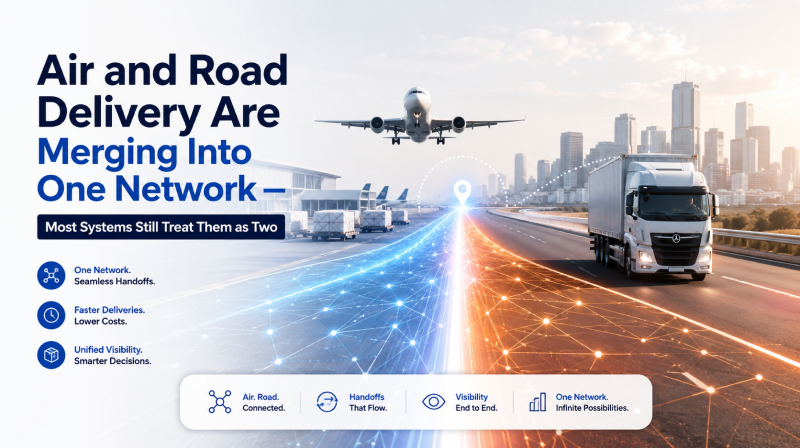
Table of Contents
Modern supply chains rarely move shipments through a single transportation mode.
A time-critical shipment may leave a local distribution center on a road vehicle, move through a regional hub, travel by air, transfer through another facility, and finally reach the customer through a road-based last-mile delivery vehicle.
Physically, that is one continuous shipment journey.
Digitally, however, many enterprises still manage those movements through separate transportation systems, carrier portals, tracking platforms, warehouse systems, and dispatch workflows.
That disconnect creates what can be called the multimodal execution gap: the difference between what is happening to a shipment in the physical network and what an enterprise can actually see, predict, and act on digitally.
The result is more than a visibility problem.
When air and road transportation operate as disconnected networks, delays become harder to predict, handoffs become harder to manage, ETAs become less reliable, and downstream teams often discover a problem only after it has already affected the customer.
The physical transportation network is already multimodal. The digital execution layer needs to become multimodal too.
For enterprise logistics organizations, the next step is not simply adding another tracking dashboard.
It is creating one operational view of the shipment journey across air, road, hubs, terminals, carriers, and last-mile operations.
What Is Multimodal Logistics Visibility?
Multimodal logistics visibility is the ability to track and understand a shipment continuously as it moves across multiple transportation modes—including air, road, linehaul, and last-mile delivery—through a connected operational view.
Instead of treating each transportation leg as an independent journey, multimodal visibility connects the events, identifiers, ETAs, and exceptions associated with the complete shipment.
Consider a shipment moving through this network:
Distribution Center → Road Transport → Air Terminal → Air Network → Regional Hub → Road Transport → Customer
A traditional approach may provide separate tracking for each stage.
A multimodal approach connects those stages into one continuous shipment journey.
This distinction becomes increasingly important as enterprises work with multiple carriers, private fleets, 3PLs, transportation modes, distribution facilities, and last-mile networks.
Get one clear view across carriers, systems, and every delivery stage.
Explore End-to-End VisibilityWhy Air and Road Logistics Can No Longer Be Managed in Isolation
Transportation networks have become increasingly interconnected.
A single shipment may involve:
- Private road fleets
- Regional and local delivery carriers
- Long-haul road networks
- Air cargo or parcel networks
- Cross-docks and distribution centers
- Third-party logistics providers
- Last-mile delivery operations
Each participant may generate its own tracking events, shipment identifiers, ETAs, and operational data.
The shipment, however, does not care which system owns each transportation leg.
If an aircraft arrives late, the downstream road operation still has to deal with the consequences.
If a cross-dock processes a shipment late, the final-mile route may need to change.
If congestion delays a road vehicle, the customer still experiences one delivery journey—not three separate transportation legs.
This creates a fundamental enterprise requirement:
Transportation systems need to understand the entire shipment journey, not just the individual transportation leg.
The challenge is therefore shifting from transportation tracking to transportation orchestration.
Where Siloed Air and Road Systems Break Down
When air and road operations run on disconnected platforms, organizations often rely on people to connect the dots.
A dispatcher, planner, or control-tower analyst may have to compare flight information, carrier updates, warehouse events, and road dispatch schedules to determine whether a shipment is still on track.
At enterprise scale, that approach becomes increasingly difficult to sustain.
Three failure points appear repeatedly.
1. Handoffs Create Visibility Blind Spots
Transportation handoffs are among the most vulnerable points in the shipment journey.
Consider a shipment moving from a regional road facility to an air terminal.
The road system may show that the shipment departed.
The air carrier may not yet show it as received.
The warehouse system may record a different event such as arrived at dock or processed at terminal.
Physically, the shipment is progressing.
Digitally, the organization may see several disconnected events with no clear representation of the shipment’s current state.
The shipment keeps moving, but the digital record can lose continuity.
This is where multimodal shipment visibility becomes critical.
A unified platform should connect events across transportation modes and facilities so that the shipment remains visible throughout the handoff.
2. Different Systems Speak Different Operational Languages
Another challenge is inconsistent milestone data.
One carrier may report:
- Departed facility
- In transit
- Arrived at terminal
- Out for delivery
Another may use:
- Tendered
- Accepted
- Flight arrived
- Received at station
A third-party logistics provider may use an entirely different event structure.
Without a common data model, these events remain difficult to correlate.
Enterprise logistics teams therefore need more than data aggregation.
They need event normalization—the ability to translate different carrier, mode, and facility events into a common operational language.
This creates a consistent view of:
- Where the shipment is
- What has already happened
- What should happen next
- Whether the shipment is still on schedule
- Whether downstream operations are at risk
3. Small Delays Can Become Large Operational Problems
A delay on one transportation leg does not necessarily remain isolated to that leg.
Imagine a shipment scheduled to arrive at an air terminal at 8:00 AM.
The flight arrives 20 minutes late.
If the downstream road operation does not receive that update quickly, the vehicle assigned to the next leg may still operate according to the original plan.
The result could be:
Air delay → missed transfer → road vehicle waiting → route disruption → missed delivery window → failed delivery attempt
The initial disruption was small.
The operational impact was not.
This is why enterprise transportation visibility needs to move beyond historical tracking toward predictive and cascading ETA management.
Siloed Transportation vs. Unified Multimodal Visibility
| Capability | Siloed Air + Road Systems | Unified Multimodal Platform |
| Shipment identity | Multiple identifiers across carriers and modes | One continuous shipment identity |
| Handoff visibility | Manual reconciliation between systems | Connected events across every transfer |
| ETA management | Leg-by-leg estimates | Predictive ETA across the complete journey |
| Delay response | Reactive after disruption occurs | Exception detection before downstream impact |
| Event data | Carrier-specific terminology | Normalized operational events |
| Road coordination | Planners manually monitor upstream events | Road operations receive relevant updates automatically |
| Customer visibility | Different tracking experiences by carrier | Consistent shipment journey |
| Exception management | Human monitoring and escalation | Automated, prioritized exceptions |
The fundamental difference is simple:
Siloed systems track transportation legs. Unified orchestration manages the shipment journey.
What Does Unified Multimodal Logistics Visibility Require?
Closing the multimodal execution gap is not simply a matter of connecting more APIs or adding another tracking dashboard.
For enterprise organizations, a unified multimodal visibility and orchestration layer needs several capabilities working together.
1. Cross-Dock and Terminal Visibility
Cross-docks, terminals, hubs, and transfer facilities are critical execution points.
They determine whether a shipment moves from one transportation leg to the next as planned.
A unified system should capture operational events such as:
- Arrival
- Check-in
- Scan
- Dock assignment
- Loading
- Unloading
- Transfer
- Departure
These events provide the operational context needed to maintain shipment visibility across handoffs.
Instead of allowing the shipment record to become fragmented at every transfer point, the system maintains continuity across the network.
The terminal should be treated as an execution checkpoint—not simply another location in a tracking timeline.
2. Predictive and Cascading ETAs
Traditional tracking often answers:
Where is the shipment now?
Enterprise logistics teams increasingly need to answer:
When will it arrive at the next operational checkpoint, and what does that mean for everything downstream?
That requires ETAs to continuously incorporate changes from multiple sources, including:
- Flight arrival information
- Road transportation status
- Traffic and congestion
- Facility processing times
- Delivery schedules
- Historical operational patterns
- Current exceptions
If an upstream transportation leg changes, the downstream ETA should change accordingly.
More importantly, the operational plan should be able to respond.
For example:
Flight delay → revised terminal ETA → updated transfer expectation → revised delivery ETA → road route or resource adjustment
This is where visibility begins to evolve into transportation orchestration.
Move beyond basic TMS capabilities and take control of complex last-mile delivery. Optimize Last-Mile Operations3. One Shipment Identity Across Transportation Modes
A shipment may have different identifiers as it moves through different carriers and transportation modes.
The air carrier may use one tracking number.
The road carrier may use another.
The warehouse may use an internal shipment or order identifier.
Without connecting these identifiers, enterprises can end up managing multiple digital records for what is physically one shipment.
A unified multimodal platform should create a common shipment identity and map the relevant identifiers to it.
This allows operational teams to see the complete journey rather than searching across multiple systems to reconstruct it.
A unified shipment identity connects the different tracking numbers, carrier events, and operational milestones associated with one physical shipment.
4. Exception Intelligence
Enterprise control towers cannot realistically monitor every shipment manually.
The objective should not be to create more alerts.
It should be to identify the exceptions that require action.
Examples include:
- An upstream flight is delayed.
- A shipment is unlikely to make its planned road transfer.
- A delivery window is at risk.
- A facility has not processed a shipment within the expected time.
- A required milestone has not occurred.
- A downstream road route needs to be reconsidered.
- A temperature or other shipment condition crosses an operational threshold.
This moves logistics teams from:
Monitoring everything
to:
Managing what matters.
That distinction becomes increasingly important as transportation networks scale across thousands of shipments, facilities, carriers, and vehicles.
From Visibility to Orchestration: The Enterprise Shift
Visibility alone does not necessarily improve execution.
Knowing that a shipment is delayed is useful.
Knowing what that delay will affect and what action should happen next is far more valuable.
This is the difference between a visibility platform and an orchestration capability.
A mature multimodal logistics architecture connects four layers.
1. Data
Collect transportation and operational events from carriers, fleets, facilities, terminals, and other systems.
2. Normalization
Convert different carrier and mode-specific events into a common operational model.
3. Intelligence
Use current conditions and operational data to identify risks, predict ETAs, and detect exceptions.
4. Orchestration
Translate those insights into operational actions across transportation, facilities, dispatch, and customer-facing workflows.
This creates a continuous operating loop:
Sense → Understand → Predict → Act
That is the foundation of a connected transportation network.
Case in Point: How an Integrated Air-Road Network Operates at Enterprise Scale
The complexity of multimodal logistics becomes much clearer when viewed through the lens of a large-scale medical logistics network.
Consider one of the nation’s largest diagnostics providers, operating a transportation network that supports 1 in 3 adults and approximately half of all hospitals and physicians in the United States.
At this scale, transportation is not simply about moving shipments from point A to point B.
It requires continuous coordination across facilities, road vehicles, air networks, hubs, drivers, and time-critical delivery windows.
The operational footprint includes:
- 2,250+ physical locations nationwide
- 75,000+ daily time-critical pickups
- 4,500+ road vehicles
- 17 dedicated cargo aircraft
- 50+ million critical shipments transported and processed annually
Why Integration Matters at This Scale
When thousands of time- and temperature-sensitive specimens move through road courier networks, regional hubs, dedicated air transportation, and destination laboratories, every handoff becomes an operational checkpoint.
A delay at one point in the network can affect downstream transportation, laboratory schedules, delivery commitments, and ultimately the customer experience.
Managing air and road as separate transportation environments makes it difficult to understand those dependencies in real time.
A unified execution layer changes that model.
By connecting the multimodal network through a single digital shipment identity, the organization can maintain continuity across transportation legs while providing operational teams with a common view of the shipment journey.
The technology can support capabilities such as:
- Continuous chain-of-custody visibility across road and air movements
- Automated dock and facility check-ins at major hubs
- Real-time shipment and milestone tracking
- Exception intelligence across transportation legs
- Connected shipment identities across carriers and modes
- Downstream visibility when an upstream transportation event changes
The result is a transportation network where an event in one part of the network can be understood in the context of what happens next.
For example:
Road pickup → Regional hub → Air movement → Destination hub → Road delivery → Laboratory
Instead of managing each stage as an isolated workflow, the entire journey can be monitored as one connected operational process.
Bring fragmented logistics systems together without slowing down your operations.
Simplify Logistics IntegrationHow nuVizz Enables Multimodal Transportation Orchestration
This type of enterprise execution is where nuVizz’s transportation orchestration technology comes into play.
nuVizz provides a connected platform for coordinating transportation, shipment visibility, dispatch, routing, and last-mile execution across complex logistics networks.
Rather than forcing enterprises to replace every system already operating in their network, the platform can connect operational data across carriers, fleets, facilities, transportation modes, and downstream delivery operations.
That creates a common execution layer where teams can move from simply seeing transportation events to understanding their downstream impact and taking action.
Visibility tells you what happened. Orchestration connects that event to what should happen next.
For enterprise organizations managing high-volume, time-critical, and multimodal transportation networks, that distinction can become critical to maintaining service levels as network complexity increases.
Want to See How It Works?
See how nuVizz can connect multimodal transportation, shipment visibility, dispatch, and last-mile execution through a unified orchestration platform.
[BOOK A DEMO]
What Are the Benefits of Unified Air-Road Visibility?
When air and road operations are managed as one connected network, the benefits extend beyond shipment tracking.
| Enterprise Impact | Operational Benefit |
| Labor utilization | Hubs, terminals, and delivery teams can better prepare for actual inbound volumes and arrival times. |
| Vehicle utilization | Road resources can be aligned more closely with changing shipment availability. |
| Delivery performance | Teams can identify at-risk shipments earlier and take corrective action before delivery commitments are missed. |
| Exception management | Planners focus on meaningful disruptions instead of manually monitoring every shipment. |
| Customer experience | Customers receive a more consistent view of shipment progress regardless of transportation mode. |
| Network efficiency | Organizations can identify recurring bottlenecks across transportation legs and transfer points. |
| Operational scalability | A common orchestration layer reduces dependence on manual reconciliation as shipment volumes and carrier relationships grow. |
The biggest opportunity is not simply reducing the time spent tracking shipments.
It is reducing the amount of reactive work created by disconnected systems.
Why Multimodal Visibility Matters for Enterprise Logistics Networks
For a small transportation operation, manually reconciling a few shipments may be manageable.
For an enterprise network involving multiple transportation modes, carriers, facilities, and thousands of daily shipments, manual coordination becomes a scalability constraint.
Enterprise logistics leaders increasingly need systems that can:
- Connect air and road transportation
- Normalize data from different carriers
- Maintain shipment identity across the journey
- Predict downstream impacts
- Prioritize exceptions
- Coordinate operational responses
- Provide consistent shipment visibility
- Integrate with existing TMS, WMS, ERP, and carrier systems
The goal is not necessarily to replace every system already operating in the network.
Instead, an orchestration layer can connect those systems and create a common operational view across the transportation ecosystem.
This approach allows enterprises to preserve existing investments while improving how transportation data and decisions flow across the network.
Turn backroom bottlenecks into faster, more efficient store operations. Optimize Store OperationsThe Enterprise Multimodal Architecture
A connected multimodal logistics network brings together data from carriers, fleets, facilities, terminals, and transportation systems into a common operational view.
The first requirement is connected transportation data.
Carrier, fleet, facility, and shipment events need to be captured across air, road, and last-mile operations.
That data then needs to be normalized so different carriers and systems can be understood through a consistent shipment and event model.
This allows an enterprise to maintain one connected view of a shipment even when it moves between different transportation providers and modes.
From there, multimodal visibility and predictive intelligence provide context around what is happening and what is likely to happen next.
Changes in flight arrivals, road transportation, facility processing, or delivery schedules can be evaluated together rather than in isolation.
The final layer is transportation orchestration—connecting those insights to operational decisions across road transportation, air networks, facilities, dispatch, and last-mile execution.
This creates a more responsive transportation network.
A flight delay can influence a downstream road ETA.
A facility delay can affect dispatch planning.
A missed milestone can trigger an operational exception.
A shipment moving across multiple carriers can remain connected through one digital journey.
For enterprise logistics organizations, the value is not simply having more transportation data.
It is creating the operational context needed to turn that data into timely decisions and actions.
Conclusion: The Future of Air and Road Logistics Is One Network
Air and road logistics already operate as one physical network.
The challenge is connecting them digitally.
For enterprise logistics teams, multimodal visibility is no longer just about tracking shipments. It is about connecting shipment events, ETAs, exceptions, and operational decisions across the entire journey.
Visibility tells you where a shipment is. Orchestration helps you decide what happens next.
As transportation networks become more complex, enterprises need a unified execution layer that connects air, road, facilities, carriers, and last-mile operations.
See how nuVizz connects multimodal transportation visibility and orchestration from a single operational platform.
FAQs
Multimodal logistics visibility is the ability to track and understand a shipment continuously as it moves across multiple transportation modes, including air, road, linehaul, and last-mile delivery, through a connected operational view. It connects shipment events, identifiers, ETAs, and exceptions across the complete transportation journey.
Air and road shipments lose visibility primarily because carriers, facilities, and transportation modes often operate on separate systems with different shipment identifiers and event definitions. Without a common data model, information can become fragmented when a shipment moves between carriers, terminals, cross-docks, and transportation modes.
An air delay can change when a shipment reaches a terminal or distribution facility, which can affect downstream road transportation, routing, labor, and delivery schedules. Without connected visibility, road operations may continue planning against outdated arrival assumptions.
Shipment visibility shows what is happening to a shipment. Transportation orchestration determines what should happen next. Visibility provides the operational information needed to understand shipment status. Orchestration connects that information to predictions, exceptions, decisions, and downstream actions.
Yes. A multimodal orchestration layer can integrate with existing TMS, WMS, ERP, carrier, fleet, and operational systems rather than requiring every transportation process to be replaced. For enterprise organizations, this approach can create a common operational view while preserving existing technology investments.