Blog
What Is Transportation and Last-Mile Delivery Optimization? Benefits, Strategies & Best Practices
Key Takeaways
- Transportation optimization improves efficiency across the entire supply chain network; last-mile delivery optimization focuses on the final, most expensive leg of that journey.
- Modern optimization blends technology, operational planning, and real-time data to raise logistics performance.
- AI, route optimization, GPS tracking, TMS platforms, telematics, and predictive analytics are the core technologies driving change.
- The payoff: lower costs, better fleet utilization, higher on-time delivery rates, and stronger customer satisfaction.
- Ongoing KPI tracking — not a one-time rollout — is what keeps optimization gains from eroding over time.
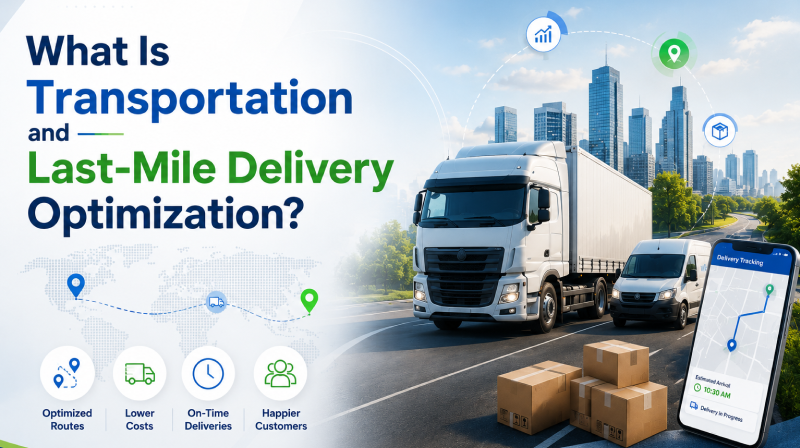
Table of Contents
Transportation is the backbone of every supply chain, and it’s under more pressure than ever. Fuel prices swing, drivers are hard to find, urban traffic keeps getting worse, and customers now expect Amazon-level visibility and speed regardless of the company shipping to them.
The response from leading logistics organizations hasn’t been to hire their way out of the problem — it’s to treat transportation as a system that can be actively optimized: better route planning, real-time visibility, and AI-driven decisions at every stage, from dispatch to final delivery.
Transportation Optimization vs. Last-Mile Delivery Optimization
These terms get used interchangeably, but they solve different problems.
| Transportation Optimization | Last-Mile Delivery Optimization | |
| Scope | End-to-end network: long-haul, regional distribution, carrier management | Final leg only: distribution center/warehouse → customer door |
| Primary focus | Network efficiency, load consolidation, carrier selection | Route sequencing, delivery windows, driver execution |
| Typical cost share | Lower per-mile cost, but larger overall spend | Represents up to 40–53% of total shipping cost despite being the shortest leg* |
| Key pain points | Fleet utilization, empty miles, compliance | Failed deliveries, narrow time windows, urban congestion |
| Core technologies | TMS, carrier management platforms, load planning | Dynamic dispatch, GPS tracking, ePOD |
Most mature logistics organizations run both in parallel: transportation optimization keeps the network efficient, and last-mile optimization protects the customer experience where it matters most — at the doorstep.
Why It Matters
- Rising customer expectations — same-day and scheduled delivery with accurate ETAs is now table stakes, not a differentiator.
- Rising costs — fuel, labor, tolls, and compliance overhead keep climbing, so unoptimized routes and underused vehicles hit margins directly.
- Growing network complexity — more warehouses, carriers, and delivery partners means more coordination surface area.
- Sustainability targets — smarter routing and higher utilization reduce empty miles and emissions, which is increasingly a reporting requirement, not just a nice-to-have.
- Competitive advantage — consistent speed and accuracy is now a retention lever, not just an operations metric.
Gain complete visibility into every shipment with real-time order tracking insights.
Learn How It WorksCommon Challenges
| Challenge | What drives it |
| Rising fuel costs | Inefficient routing, excessive idling, unnecessary mileage |
| Traffic congestion | Urban delivery density, unpredictable conditions |
| Driver shortages | Fewer available drivers relative to delivery volume |
| Narrow delivery windows | Rising customer expectations for scheduled slots |
| Manual route planning | Doesn’t scale, ignores real-time conditions |
| Limited visibility | No real-time tracking, slower response to delays |
| Failed deliveries | Bad addresses, customer unavailability, poor communication |
| Reverse logistics | Returns require their own optimized pickup routes |
| Regulatory compliance | Driver hours, ELDs, safety, environmental standards |
Strategies That Actually Move the Needle
- Intelligent route optimization — beyond shortest-distance routing: factoring in time windows, vehicle capacity, driver hours, and multi-stop sequencing simultaneously.
- Real-time visibility — GPS and telematics so dispatchers see delays as they happen, not after a customer complains.
- Automated dispatch — rules-based or AI-driven assignment as volume scales past what manual dispatching can handle.
- Vehicle utilization — load consolidation and multi-order delivery to cut empty miles.
- AI/ML — continuously re-optimizing routes and forecasting delays rather than relying on static plans.
- Proactive customer communication — automated ETAs and delay alerts reduce failed deliveries and support tickets alike.
- Territory redesign — fixing overlapping routes caused by delivery zones that no longer match actual demand density.
- Continuous KPI monitoring — treating optimization as an ongoing discipline, not a one-time project.
- System integration — connecting TMS with WMS, ERP, OMS, and CRM to eliminate data silos.
- Historical data analysis — using past delivery data to catch recurring, fixable inefficiencies.
The Role of AI
Traditional planning relies on static routes and dispatcher experience. AI-powered systems instead evaluate live conditions — traffic, weather, driver schedules, vehicle capacity — and continuously recompute the best plan.
Practical applications include: dynamic route optimization, predictive ETAs, demand forecasting, automated scheduling, predictive maintenance, and exception detection. The organizations getting the most value combine AI with real-time visibility rather than treating it as a bolt-on feature.
Enabling Technologies
| Technology | What it does |
| TMS (Transportation Management System) | Central platform for planning, dispatching, tracking, and reporting |
| AI-powered route optimization | Recalculates routes continuously against dozens of live constraints |
| GPS tracking | Real-time vehicle location and planned-vs-actual route comparison |
| ePOD (electronic proof of delivery) | Digital signatures, photos, timestamps — replaces paper records |
| Telematics | Vehicle health, driver behavior, fuel use, idle time |
| IoT | Cargo condition monitoring — temperature, humidity, asset tracking |
| Predictive analytics | Forecasts delays, demand, and maintenance needs before they happen |
| Cloud platforms | Scalable, easier integration with carriers and partners |
Industry Applications
- Retail — store replenishment, same-day fulfillment
- E-commerce — high-volume order fulfillment, multi-carrier management, returns
- Healthcare/pharma — cold chain integrity, regulatory compliance
- Food & beverage — perishability, temperature-sensitive scheduling
- Manufacturing — just-in-time inbound/outbound coordination
- 3PL — balancing multiple clients’ service levels on shared fleets
KPIs Worth Tracking
| KPI | Why it matters |
| On-time delivery rate | Direct proxy for customer satisfaction and service reliability |
| Delivery success rate (first attempt) | Failed deliveries are expensive to redo |
| Transportation cost per delivery | Core efficiency and cost-control metric |
| Average delivery time | Faster cycles improve service perception |
| Fleet utilization | Idle assets are wasted capital |
| Vehicle capacity utilization | Fewer trips needed per unit of freight |
| Fuel consumption | Directly ties to cost and emissions |
| Empty miles % | Unloaded travel is pure margin loss |
| Route efficiency (planned vs. actual) | Flags planning gaps for the next cycle |
| Customer satisfaction (CSAT) | The outcome metric everything above should be driving |
Best Practices
- Make decisions on data, not assumptions — track delivery performance, cost, and utilization regularly.
- Extend visibility end-to-end — from order creation through returns, not just “truck on the road.”
- Standardize processes — dispatch workflows, documentation, and exception handling shouldn’t vary by shift or region.
- Automate where it scales — route planning, notifications, and reporting free up teams for higher-value work.
- Invest in driver tools — mobile apps, ePOD, and real-time comms reduce friction on the ground.
- Review performance on a cadence — quarterly, not “when something breaks.”
Where This Is Heading
- AI/ML — autonomous dispatch planning, predictive disruption management
- Predictive logistics — anticipating delays before they happen rather than reacting
- Autonomous delivery — robots and drones in controlled, limited use cases
- EV fleets — lower fuel cost and emissions as charging infrastructure matures
- Digital twins — simulating route and fleet changes before implementing them in the real network
Conclusion
Transportation and last-mile delivery optimization aren’t side projects anymore — they’re operational necessities. Manual planning and static routes can’t keep pace with rising customer expectations, tighter margins, and increasingly complex delivery networks.
The organizations getting this right aren’t relying on any single tool. They’re combining real-time visibility, AI-driven routing, and a genuine discipline around measuring KPIs — then using that data to keep improving instead of treating optimization as a one-time rollout.
The bottom line: whether you’re managing regional distribution or thousands of daily last-mile stops, optimization is what lets you deliver reliably today while staying ready for whatever the network looks like next year.
FAQs
The process of improving how goods are planned, routed, and delivered to reduce cost and improve service across the supply chain.
Optimizing the final delivery leg — warehouse or distribution center to the customer's door — using routing, dispatching, and real-time visibility.
It analyzes live data to optimize routes, predict delays, automate dispatch, and forecast demand — continuously, not as a one-time plan.
TMS, route optimization software, GPS, ePOD, telematics, IoT, predictive analytics, and cloud logistics platforms.
Retail, e-commerce, healthcare/pharma, food and beverage, manufacturing, and 3PL — anywhere delivery reliability and cost control both matter.
Fuel costs, traffic, driver shortages, narrow delivery windows, limited visibility, and failed deliveries.