Blog
Dozens of Carriers, Dozens of Systems: Why Delivery Networks Still Lack End-to-End Visibility
Key Takeaways
- Multi-carrier delivery networks create flexibility but also significant data complexity.
- Tracking individual shipments does not automatically provide network-wide visibility.
- Carrier-specific systems, inconsistent event definitions, and handoffs can create blind spots.
- A common data model helps turn fragmented carrier information into a unified operational view.
- Effective visibility should cover status, ETA, exceptions, handoffs, performance, and customer impact.
- Visibility becomes more valuable when it is connected to workflows and operational decisions.
- The objective is not to eliminate carrier complexity, but to make that complexity visible and manageable.
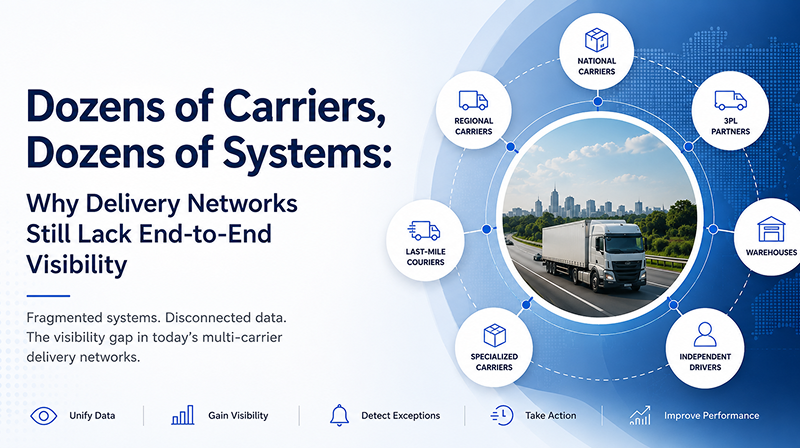
Table of Contents
A modern delivery network rarely depends on a single carrier.
A shipment might move through a national parcel carrier, a regional delivery company, a specialized freight provider, a local courier, a final-mile contractor, or a third-party logistics provider. In larger networks, several of these partners may operate simultaneously across different regions, service levels, and transportation modes.
That flexibility is valuable. It helps companies expand geographic coverage, control transportation costs, handle seasonal demand, and match shipments to the right service provider.
But it creates another problem that is much harder to solve:
How do you see what is happening across the entire network when every carrier sees only its own part of it?
The challenge is not necessarily a lack of tracking technology. Most carriers have tracking systems. The problem is that those systems were not designed to create one unified view of a shipper’s entire delivery network.
One carrier may provide an API. Another may rely on EDI. A regional carrier may use a web portal. A smaller provider may send spreadsheets or email updates. A 3PL may introduce another layer of systems between the shipper and the actual transportation provider.
The result is a delivery network that can be highly connected physically while remaining surprisingly fragmented digitally.
And that fragmentation can make end-to-end visibility much harder than simply tracking a shipment.
The Multi-Carrier Delivery Network Is the New Normal
Companies use multiple carriers for good reasons.
A single transportation provider may not offer the right combination of geographic coverage, capacity, pricing, delivery speed, or specialized services for every shipment.
A retailer, for example, might use:
- A national parcel carrier for standard residential deliveries
- Regional carriers for specific geographic markets
- Local couriers for same-day delivery
- Freight carriers for oversized shipments
- Specialized providers for temperature-sensitive products
- Dedicated transportation providers for high-volume lanes
- 3PLs to manage specific regions or fulfillment operations
The same organization may therefore have dozens of transportation relationships without having dozens of corresponding visibility connections.
This distinction matters.
Physical network complexity does not automatically translate into digital visibility.
Research into multi-carrier logistics describes the transportation industry as highly fragmented, particularly among regional and smaller carriers that often operate independently across specific regions or corridors.
At the same time, current logistics technology discussions increasingly focus on consolidating carrier-specific tracking into unified visibility architectures rather than managing every carrier separately.
The more carriers a network adds, the more important that distinction becomes.
Tracking a Shipment Is Not the Same as Seeing the Network
This is where many visibility conversations become confusing.
A shipment can be “trackable” without the company having network-level visibility.
Imagine a company has 20 carriers.
Each carrier provides tracking information.
Carrier A has its own dashboard.
Carrier B provides an API.
Carrier C sends EDI events.
Carrier D updates a portal.
Carrier E provides only milestone notifications.
The remaining carriers use different combinations of systems.
Technically, the company may have tracking information for every carrier.
Operationally, however, employees may still have to move between multiple systems to answer a basic question:
What is happening across our delivery network right now?
That is the difference between tracking and visibility.
Tracking answers:
Where is this shipment?
Visibility answers:
What is happening across the network, which shipments are at risk, which carriers are underperforming, and what should we do about it?
The second question requires much more than location data.
It requires data normalization, consistent milestones, comparable performance metrics, exception management, and context.
Turn last-mile challenges into smarter, more efficient deliveries.
See How nuVizz WorksThe Problem Starts With Fragmented Data
Every carrier has its own operational environment.
One carrier might define “picked up” differently from another.
One might send an event when a package leaves a facility. Another might send an event only when it reaches the next hub.
One system might use a standard status such as “Out for Delivery.”
Another might use a carrier-specific code that means roughly the same thing.
These differences create a data translation problem.
A shipper trying to build a network-wide view must bring together information from systems that were never designed around a common data model.
A typical logistics technology environment can include:
- Transportation management systems
- Warehouse management systems
- Carrier portals
- EDI connections
- APIs
- Telematics platforms
- GPS feeds
- Customer service systems
- ERP systems
- 3PL platforms
- Spreadsheet-based processes
- Email-based updates
Supply Chain Management Review noted in 2026 that many shippers operate across multiple platforms, including TMS, WMS, carrier portals, rail systems, and financial tools, creating conflicting data and slowing disruption response.
This means the visibility problem is often less about whether data exists and more about whether the data can be connected and understood consistently.
Carrier Handoffs Create Some of the Biggest Blind Spots
The most difficult visibility problems often occur at transitions.
A shipment moves from one organization to another.
For example:
Warehouse → Carrier A → Regional Carrier B → Local Delivery Provider → Customer
Each handoff creates an opportunity for information to become delayed, incomplete, or disconnected.
The physical shipment continues moving.
But the digital record may not.
This is particularly important in multimodal and multi-provider transportation. Research published in 2025 identified delayed data updates, transshipment blind spots, inconsistent reporting, and fragmented systems as continuing challenges to end-to-end visibility.
Consider a simple example.
A shipment is transferred from a national carrier to a regional partner.
The national carrier’s system shows:
Transferred to delivery partner
The regional carrier’s system shows:
Shipment received
But those two events may not be connected in the shipper’s system.
For several hours, the shipment can effectively appear to exist in two different digital worlds.
The package is moving.
The data is fragmented.
That is a visibility gap.
Why More Dashboards Don’t Necessarily Solve the Problem
One obvious response to fragmented visibility is to add more dashboards.
But dashboards alone do not create a unified network view.
If an operations team has to monitor:
- Carrier portal A
- Carrier portal B
- TMS dashboard
- 3PL dashboard
- GPS platform
- Warehouse system
- Customer service platform
then the organization may have more information without necessarily having more visibility.
The employee becomes the integration layer.
Someone has to compare statuses, identify discrepancies, determine which event is current, and decide whether an exception requires action.
This creates another hidden problem:
Human attention becomes part of the visibility architecture.
That approach may work when shipment volumes are small.
It becomes increasingly difficult as networks grow.
The Cost of Fragmented Visibility
Poor visibility does not always create one dramatic failure.
More often, it creates dozens of smaller operational problems.
1. Delayed exception detection
A shipment may be delayed long before someone notices.
If a carrier’s exception event is not integrated into the primary operational workflow, the issue may remain hidden until a customer calls.
2. More manual investigation
Customer service and transportation teams spend time searching multiple systems to answer basic shipment questions.
Instead of solving exceptions, employees spend time locating information.
3. Inconsistent ETAs
Different systems may calculate or report arrival estimates differently.
That can create conflicting information between transportation teams, customer service representatives, and customers.
4. Difficulty comparing carriers
A carrier may appear to have a different performance profile simply because its data is reported differently.
Without standardized metrics, comparing on-time performance, exception rates, delivery times, or failed delivery rates becomes difficult.
5. Slower response to disruptions
Visibility matters most when something goes wrong.
If a disruption is detected late, the organization has fewer options to recover.
6. Customer experience problems
Customers do not care which carrier has the data.
They care about one question:
Where is my order, and when will it arrive?
A fragmented backend can therefore become a fragmented customer experience.
Ready to simplify retail fulfillment from order to doorstep? Explore Retail Delivery SolutionsThe Real Challenge: Creating One Common View
True end-to-end visibility does not necessarily mean replacing every carrier system.
That would be unrealistic.
Instead, the goal is to create a common visibility layer that can interpret information coming from different transportation partners.
This requires several capabilities.
1. Data integration
Carrier information needs to enter a centralized environment through appropriate methods such as APIs, EDI, webhooks, telematics, or other data feeds.
2. Data normalization
Different carrier events need to be translated into a consistent operational language.
For example:
Carrier A: Out for delivery
Carrier B: Vehicle dispatched
Carrier C: Delivery route started
The system should be able to recognize that these events represent a similar operational state.
3. Shipment identity
A shipment may have different identifiers as it moves between systems.
Connecting those identifiers is essential to maintaining continuity throughout the journey.
4. Event sequencing
Visibility requires understanding not only individual events but their sequence.
Picked up → In transit → Arrived at hub → Transferred → Out for delivery → Delivered
When an expected event does not occur, that absence can itself become important.
5. Exception intelligence
A visibility system should not simply show that something is late.
It should help determine:
- What happened?
- Where did it happen?
- Which shipment is affected?
- Which carrier is responsible?
- How serious is the issue?
- What is the expected impact?
- Does someone need to intervene?
That turns visibility from passive tracking into operational intelligence.
Visibility Should Be Carrier-Agnostic
One of the most important principles in a multi-carrier environment is that the customer experience should not depend on which carrier is executing the shipment.
From the shipper’s perspective, the network should look like one connected operation.
The customer should not need to know:
“Your shipment changed from Carrier A to Carrier B, so you need to check another tracking system.”
The operations team should not have to think:
“Which carrier portal contains the latest status?”
Instead, the network should provide a consistent view regardless of who is moving the shipment.
Current industry thinking around multi-carrier visibility increasingly emphasizes this carrier-agnostic approach: common tracking models, comparable performance data, and a unified experience across different transportation providers.
Visibility Is Also About Performance, Not Just Location
A map showing thousands of shipments may look impressive.
But a map is not necessarily operational visibility.
A useful visibility system should help organizations understand performance.
For example:
| Visibility Area | Questions the Network Should Answer |
| Shipment status | Where is the shipment now? |
| ETA | When is it expected to arrive? |
| Carrier performance | Which carriers are meeting commitments? |
| Exceptions | What has gone wrong? |
| Handoffs | Where has custody changed? |
| Geography | Which regions have recurring issues? |
| Service level | Are promised delivery windows being met? |
| Customer impact | Which customers or orders are affected? |
| Cost | What operational impact is the disruption creating? |
| Recovery | What action can reduce the impact? |
This is why end-to-end visibility should be viewed as an operational capability, not merely a tracking feature.
From Visibility to Action
There is another important distinction.
Knowing that a shipment is delayed is useful.
Knowing what to do about the delay is more valuable.
For example, imagine a carrier reports that a shipment will miss its delivery commitment.
A basic tracking platform might display:
Delayed — ETA changed from Tuesday to Wednesday
A more operationally useful system could identify:
- The shipment’s customer commitment
- The cause of the delay
- The affected delivery window
- Other shipments in the same region
- Whether the carrier has available recovery capacity
- Whether another service option exists
- Whether customer communication is required
This is the evolution from visibility to decision support.
Supply Chain Management Review has highlighted a similar issue: tracking and dashboards can generate large amounts of data, but visibility alone does not necessarily produce better decisions unless it is connected to workflows and execution.
Why Integration Quality Matters More Than the Number of Integrations
A company can claim to have integrated 50 carriers and still have poor visibility.
The important question is not:
How many carriers are connected?
It is:
How consistently and reliably does their data become usable operational information?
An integration that sends one tracking update every several hours may not provide the same operational value as a reliable real-time event stream.
Likewise, an integration that captures location but not exceptions, handoffs, proof of delivery, or service commitments may leave important gaps.
The goal should therefore be meaningful coverage, not simply integration volume.
What a Truly Connected Delivery Network Looks Like
A mature multi-carrier visibility environment has several characteristics.
1. One operational view
Teams can see shipments across carriers without switching between multiple carrier-specific dashboards.
2. Consistent shipment states
Different carrier terminology is translated into a common operational language.
3. Continuous shipment identity
The shipment remains connected across carrier changes, handoffs, and transportation legs.
4. Real-time or appropriately timed updates
The frequency of data reflects the operational importance of the shipment and event.
5. Exception-first workflows
Teams are not forced to manually search thousands of shipments to find the few that require attention.
6. Comparable carrier performance
Carrier data is standardized enough to support meaningful benchmarking.
7. Customer-facing consistency
Customers receive a coherent experience regardless of which carrier executes the delivery.
8. Actionable information
Visibility is connected to decisions and workflows rather than existing only as another dashboard.
Struggling to keep up with today’s last-mile delivery complexity?
Explore Smarter Last-Mile TMSThe Future of Multi-Carrier Visibility
The direction of logistics technology is moving beyond isolated tracking systems.
The next stage is increasingly about connectivity, normalization, and orchestration.
Artificial intelligence can add another layer by identifying patterns across large volumes of transportation data.
For example, AI could help identify:
- Repeated delays on specific lanes
- Carrier performance deterioration
- Unusual transit times
- Emerging regional disruptions
- Shipment combinations likely to experience problems
- Exceptions that require human intervention
But AI does not eliminate the underlying data problem.
If the underlying carrier data is incomplete, inconsistent, or disconnected, sophisticated analytics will still be working with an imperfect picture.
In other words:
Better intelligence starts with better-connected data.
That is why data architecture remains fundamental to visibility.
The Goal Isn’t to Eliminate Carrier Complexity
Using multiple carriers is not inherently a problem.
In many cases, it is a strategic advantage.
Multiple carriers can provide:
- Geographic flexibility
- Additional capacity
- Competitive pricing
- Specialized capabilities
- Faster delivery options
- Business continuity
- Reduced dependence on a single provider
The objective is therefore not to make a complex transportation network simple.
The objective is to make the complexity manageable and visible.
A company can have dozens of carriers and still operate with a unified view.
The key is ensuring that the systems connecting those carriers can translate fragmented information into one operational picture.
A Practical Framework for Improving Multi-Carrier Visibility
Organizations looking to address visibility gaps can start with a few practical questions.
1. Map every carrier and logistics partner
Identify every transportation provider involved in the network, including regional and specialized providers that may not appear in high-level reporting.
2. Document every source of shipment data
List APIs, EDI connections, portals, spreadsheets, telematics systems, email workflows, and other data sources.
3. Identify visibility gaps
Look specifically at handoffs, transportation legs, regional operations, and carriers with delayed or incomplete updates.
4. Standardize critical events
Define a common set of shipment milestones and exception categories.
5. Establish a common shipment identity
Ensure shipments can be tracked continuously when identifiers change between systems.
6. Prioritize exceptions
Not every shipment needs human attention.
Build processes that surface the events most likely to affect customer commitments, cost, or service.
7. Measure carrier performance consistently
Use standardized metrics across carriers wherever possible.
8. Connect visibility to action
Make sure the people responsible for resolving exceptions can act directly from the information they receive.
Conclusion
Modern delivery networks rely on multiple carriers, 3PLs, regional providers, and technology platforms. That flexibility creates a visibility challenge: each provider generates its own piece of the data.
End-to-end visibility means connecting and standardizing those pieces so teams can quickly see what is happening, what is at risk, and what action is needed.
The goal isn’t another dashboard. It’s turning dozens of disconnected systems into one connected view of the delivery network.
Want to see what network-wide visibility can look like for your delivery operation?
FAQs
Multi-carrier visibility is difficult because each carrier may use different systems, data formats, tracking events, and update processes. Connecting these sources into one consistent operational view can be challenging, especially when shipments move between carriers.
End-to-end delivery visibility means having a connected view of a shipment throughout its journey, including carrier handoffs, transportation milestones, exceptions, estimated delivery times, and final delivery.
Businesses can improve visibility by connecting carrier data through APIs, EDI, and other integrations, standardizing shipment events, and bringing the information into a centralized operational view.
Fragmented visibility can lead to delayed exception detection, manual tracking, inconsistent shipment information, difficulty comparing carrier performance, and slower responses to delivery problems.
Yes. A multi-carrier visibility platform can connect information from different transportation providers and present it through a common view, helping logistics teams monitor shipments, identify exceptions, and understand carrier performance across the network.