Blog
What are the benefits of using nuVizz for logistics and delivery services?
Key Takeaways
- nuVizz is an AI-powered logistics and delivery orchestration platform.
- AI-driven route optimization helps reduce fuel consumption, mileage, and driver hours.
- Automated dispatch and predictive ETAs improve delivery efficiency and visibility.
- Digital ePOD and real-time tracking help reduce missed deliveries and improve on-time performance.
- nuVizz connects shippers, carriers, 3PLs, and fleets on a unified platform.
- Integrated billing and settlement workflows help streamline post-delivery operations.
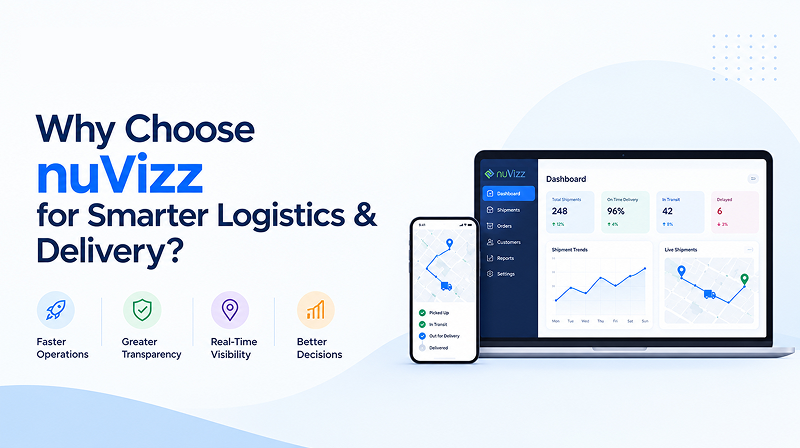
Logistics and delivery operations are becoming increasingly complex. Higher delivery volumes, tighter delivery windows, rising operating costs, and growing customer expectations are putting pressure on businesses to improve how they plan and execute deliveries.
Managing these challenges through disconnected systems, manual dispatch processes, and limited shipment visibility can make it difficult to maintain efficiency at scale.
nuVizz combines AI-powered route optimization, automated dispatch, predictive visibility, digital delivery execution, and settlement workflows within a unified logistics platform.
For businesses managing enterprise delivery networks, the benefits go beyond vehicle tracking. nuVizz can help organizations:
- Optimize routes and reduce unnecessary mileage
- Automate dispatch and improve fleet productivity
- Gain predictive visibility across deliveries
- Reduce missed deliveries and improve on-time performance
- Standardize operations across multi-carrier networks
- Digitize proof of delivery and delivery compliance
- Accelerate billing and settlement processes
Why Businesses Need Smarter Logistics and Delivery Management
Traditional delivery operations often depend on multiple systems and manual processes. Dispatchers may use one system for planning, another for tracking, and separate processes for proof of delivery, billing, and carrier settlements.
This fragmentation can create data silos, reporting delays, and limited operational visibility.
Challenges With Traditional Delivery Operations
As delivery networks become more complex, logistics teams commonly face:
- Manual route and dispatch planning
- Limited visibility into delivery progress
- Difficulty responding to traffic and operational disruptions
- Missed delivery windows and failed delivery attempts
- Paper-based proof of delivery
- Disconnected carrier and fleet information
- Delays in billing and settlement processes
Static delivery plans can also become outdated quickly. Traffic changes, driver shortages, vehicle breakdowns, priority orders, and order modifications can all disrupt the original schedule.
The Role of AI and Delivery Orchestration
AI and delivery orchestration help logistics teams move from reactive management toward more connected and proactive operations.
Instead of treating planning, dispatch, tracking, execution, and settlement as separate activities, an orchestration platform connects these processes and uses operational data to support faster decisions.
This creates a more continuous flow of information from planning through financial settlement.
Need a smarter way to manage complex last-mile transportation operations?
Explore Last-Mile TMSKey Benefits of Using nuVizz for Logistics and Delivery Services
nuVizz brings planning, dispatch, delivery execution, visibility, and settlement workflows together in one connected platform. By combining AI-driven optimization with real-time operational data, it helps logistics teams address everyday delivery challenges while improving efficiency, control, and customer experience.
The key benefits include:
1. Optimize Routes and Reduce Fuel & Mileage
Route efficiency has a direct impact on delivery costs. Inefficient routes can increase:
- Fuel consumption
- Vehicle mileage
- Driver hours
- Delivery times
- Overall operating costs
nuVizz uses AI-powered route optimization to evaluate multiple delivery constraints, including:
- Vehicle capacity
- Delivery time windows
- Driver availability
- Traffic conditions
- Order priorities
Routes can also be recalculated when conditions change during the delivery day.
How this helps
Instead of relying entirely on static routes created before vehicles leave the depot, logistics teams can respond to real-world disruptions and changing delivery conditions.
nuVizz impact: 20–25% reduction in fuel consumption and vehicle mileage.
For high-volume delivery networks, reducing unnecessary miles can translate into meaningful operational savings while improving fleet utilization.
2. Automate Dispatch and Improve Fleet Productivity
As delivery volumes increase, dispatching becomes more difficult. Operations teams need to continuously monitor vehicles, drivers, orders, and changing delivery requirements.
nuVizz supports automated dispatch through RoboDispatch™, helping reduce repetitive dispatcher activities.
The system can consider:
- Available vehicles
- Driver capacity
- Delivery priorities
- Route requirements
- Changing operational conditions
When circumstances change, dispatch plans can be adjusted without requiring teams to rebuild the entire plan manually.
How this helps
Automation allows operations teams to spend less time on repetitive dispatch tasks and more time managing exceptions and higher-value operational decisions.
Capability: Dispatch controllers can manage 2–3× more delivery routes without a proportional increase in operational overhead.
This can be particularly useful for organizations looking to increase delivery capacity without increasing administrative workload at the same rate.
3. Gain Real-Time Predictive Visibility Across Deliveries
Visibility is critical for both logistics teams and customers.
When delivery information is delayed or spread across different systems, operations teams may struggle to identify problems while customers may repeatedly contact support for shipment updates.
nuVizz provides real-time visibility across delivery operations, supported by predictive ETA capabilities.
The platform uses field and operational data to continuously update expected arrival times.
Performance: 90–95% predictive ETA accuracy.
How this helps
More accurate ETAs can help logistics teams:
- Identify potential delays earlier
- Monitor delivery progress
- Manage SLA risks
- Communicate more accurate delivery expectations
- Reduce routine WISMO inquiries
Predictive visibility also supports proactive exception management. Rather than waiting until a delivery becomes late, teams can identify potential issues and determine an appropriate corrective action.
Automated tracking information and live delivery updates can further improve the customer experience.
4. Reduce Missed Deliveries and Improve On-Time Performance
A missed delivery can create costs beyond the original transportation expense.
A failed attempt may require:
- Another delivery trip
- Additional driver hours
- More vehicle mileage
- Additional fuel
- Customer-service effort
nuVizz brings together route optimization, predictive visibility, dispatch automation, and exception management to help organizations address delivery risks earlier.
For example, changing traffic conditions or another operational disruption may put a delivery window at risk. Earlier visibility into the problem gives operations teams an opportunity to respond.
Performance
- Up to 70% reduction in missed delivery segments
- 96–98.5%+ on-time delivery performance across high-volume networks
Actual results can vary based on the operating environment, delivery model, baseline performance, and network complexity. Businesses should therefore evaluate these metrics against their own operational baseline.
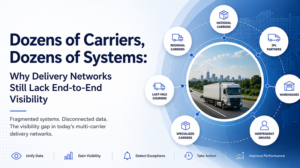
5. Standardize Operations Across Multi-Carrier Networks
Enterprise logistics networks often involve multiple transportation providers rather than a single fleet.
A business may work with:
- Private fleets
- Dedicated carriers
- Regional logistics providers
- 3PLs
- Other delivery partners
Managing these parties through disconnected systems can make it difficult to maintain consistent processes and performance visibility.
nuVizz functions as a multi-tenant cloud platform designed to connect shippers, carriers, 3PLs, terminals, and other delivery stakeholders within a common operational environment.
How this helps
A unified environment can provide:
- A centralized source of delivery information
- Standardized execution processes
- Consistent operational KPIs
- Greater carrier performance visibility
- Better coordination across logistics partners
For enterprise organizations, this can reduce operational silos and provide a more consistent view of delivery activity across different fleets and transportation providers.
6. Improve Delivery Compliance With Digital ePOD
Proof of delivery is a critical part of delivery execution. Paper manifests and manually recorded delivery information can make it harder to verify completed deliveries, investigate disputes, and maintain an accurate audit trail.
nuVizz supports digital field execution and electronic proof of delivery (ePOD) through mobile workflows.
Delivery processes can include:
- Barcode scanning
- Digital signatures
- Geotagged timestamps
- Photographic evidence
- Digital delivery confirmation
How this helps
Digital execution creates a structured record of delivery activity and strengthens chain-of-custody visibility.
This can be especially valuable for industries where delivery verification and traceability are important, including:
Automotive | Healthcare | Pharmaceuticals | High-value distribution
Moving delivery confirmation into a digital workflow can also reduce paperwork and minimize manual effort associated with collecting and reconciling delivery documentation.
7. Accelerate Billing, Settlements, and Cash Flow
The delivery process does not end when a driver completes a stop.
Verified delivery information may need to flow into:
- Client billing
- Freight auditing
- Driver settlements
- Carrier payments
- Other financial processes
When these activities depend on paper documents or manually transferred information, settlement cycles can become slower and more prone to reconciliation issues.
nuVizz connects operational delivery events with downstream financial workflows. Verified ePOD information can feed into billing, freight auditing, and driver or carrier settlement processes.
Performance: 30% faster settlement cycles.
How this helps
By reducing manual data entry and reconciliation, businesses can shorten the time between completed delivery activity and financial processing.
For logistics organizations handling large delivery volumes, improving this cash-to-cash lifecycle can become an important operational advantage.
Need a smarter way to plan efficient delivery routes at scale? Find the Right Route PlannerMeasuring the Business Impact of nuVizz
A logistics technology investment should be measured through operational KPIs rather than simply comparing software features.
The performance metrics associated with nuVizz include:
| KPI | Documented nuVizz Impact |
| Missed delivery segments | Up to 70% reduction |
| Fuel consumption & mileage | 20–25% reduction |
| Driver hours & operating miles | 30–35% reduction |
| On-time delivery | 96–98.5%+ |
| Predictive ETA accuracy | 90–95% |
| Settlement cycles | 30% faster |
Businesses evaluating a delivery platform should compare these metrics against their own operational baseline.
Results can differ depending on:
- Fleet composition
- Delivery density
- Geographic coverage
- Existing processes
- Network complexity
- Delivery model
This makes establishing a baseline before implementation important for measuring the actual impact of a logistics platform.
How nuVizz Supports Different Logistics Operations
nuVizz can support different stakeholders and delivery models across complex logistics networks.
Enterprise Shippers and OEMs
Enterprise shippers and OEMs can use centralized delivery visibility to coordinate multiple carriers and standardize execution across distribution networks.
Key applications include:
- Coordinating complex distribution networks
- Monitoring carrier performance
- Tracking operational KPIs
- Standardizing delivery workflows
- Improving visibility across logistics partners
Logistics Service Providers and Carriers
LSPs and carriers can use nuVizz capabilities to improve fleet and delivery operations through:
- Route optimization
- Automated dispatch
- Fleet visibility
- Digital delivery workflows
- Automated settlement processes
- Improved resource utilization
These capabilities can also help providers support higher delivery volumes without increasing administrative effort at the same rate.
Industry-Specific Delivery Operations
nuVizz can support a range of specialized delivery environments.
Automotive and Parts Distribution
- Multi-stop dealership deliveries
- Time-sensitive parts movement
- Item-level traceability
Healthcare and Pharmaceutical Logistics
- Delivery visibility
- Digital chain-of-custody records
- Time-critical shipment workflows
Retail and E-commerce
- Scheduled last-mile deliveries
- Dynamic delivery windows
- Customer tracking
- High-volume delivery execution
Big-and-Bulky and White-Glove Delivery
- Complex delivery scheduling
- Delivery execution management
- Digital completion records
Ready to reduce delivery costs and improve last-mile efficiency with AI?
Find the Right SoftwareWhat Sets nuVizz Apart From Fragmented Delivery Management?
The key difference between fragmented delivery management and an orchestration-based approach is how information moves through the delivery lifecycle.
A Fragmented Model
Planning → Separate Dispatch → Separate Tracking → Manual Delivery Confirmation → Manual Billing
In this environment, information may need to be transferred manually between systems, creating delays and data gaps.
An Orchestrated Model
Planning → Dispatch → Delivery Execution → Predictive Visibility → ePOD → Billing & Settlement
nuVizz brings these capabilities together within a unified logistics platform.
Operational events captured during delivery execution can then support:
- Real-time visibility
- Exception management
- Delivery compliance
- Proof of delivery
- Billing
- Freight auditing
- Driver and carrier settlements
For organizations managing high-volume or multi-party delivery networks, connecting these processes can reduce operational silos and create a more consistent flow of information.
Is nuVizz Suitable for Your Logistics Operation?
The suitability of any logistics platform depends on the specific operating environment.
Businesses should consider factors such as:
- Delivery volume
- Fleet size
- Geographic coverage
- Number of transportation partners
- Delivery-window requirements
- Network complexity
- Existing technology environment
- Level of automation required
nuVizz can be particularly relevant for organizations managing complex, high-volume, multi-carrier delivery networks that need greater automation, real-time visibility, and coordination across the delivery lifecycle.
Before adopting a platform, businesses should establish their current operational baseline and identify the KPIs they want to improve. This provides a clearer way to measure the technology’s value after implementation.
Conclusion
Modern logistics operations require more than basic vehicle tracking. Businesses need connected processes that support route planning, dispatch, delivery execution, visibility, compliance, and financial settlement.
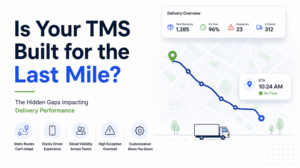
nuVizz brings these capabilities together through an AI-powered last-mile TMS and delivery orchestration platform.
Its performance metrics include:
- 20–25% lower fuel consumption and mileage
- Up to 70% fewer missed delivery segments
- 96–98.5%+ on-time delivery performance
- 90–95% predictive ETA accuracy
- 30% faster settlement cycles
- 30–35% reduction in driver hours and operating miles
For businesses seeking to modernize complex logistics and delivery operations, an integrated approach such as nuVizz can provide a foundation for improving operational visibility, efficiency, delivery performance, and scalability across the delivery lifecycle.
FAQs
nuVizz is an AI-powered last-mile TMS and delivery orchestration platform used to manage route optimization, dispatch, real-time delivery visibility, digital proof of delivery, and billing and settlement workflows.
nuVizz helps improve last-mile delivery by optimizing routes, automating dispatch, providing predictive ETAs, identifying potential delivery exceptions, and digitizing delivery execution. These capabilities can help reduce mileage, missed deliveries, and manual operational work.
Yes. nuVizz is designed to reduce costs through route optimization, improved fleet utilization, automated dispatch, and reduced driver hours and mileage. Documented performance metrics indicate a 20–25% reduction in fuel consumption and mileage and a 30–35% reduction in driver hours and operating miles.
nuVizz connects delivery operations across planning, dispatch, field execution, and tracking to provide real-time operational visibility. Its predictive ETA capabilities can provide 90–95% ETA accuracy, helping logistics teams identify potential delays and keep customers informed.
nuVizz is designed to support complex, high-volume delivery networks involving shippers, carriers, 3PLs, fleets, terminals, and other stakeholders. Its multi-tenant platform can help businesses standardize delivery workflows, monitor carrier performance, and manage operations through a centralized environment.