Blog
The Hidden Factors Driving Supply Chain Turnover
Key Takeaways
- Supply chain turnover is often driven by hidden operational inefficiencies, including poor planning, limited visibility, disconnected systems, and reactive execution.
- Limited supply chain visibility can amplify disruptions by delaying the identification and resolution of shipment, delivery, and transportation exceptions.
- Manual route planning and dispatch can limit scalability, increase operational workload, and contribute to inefficient transportation utilization.
- Supply chain orchestration connects planning, optimization, dispatch, execution, and real-time visibility, helping organizations respond more effectively to changing conditions.
- nuVizz helps enterprises optimize delivery and transportation operations through route optimization, intelligent dispatch, real-time visibility, exception management, delivery execution, and customer communication.
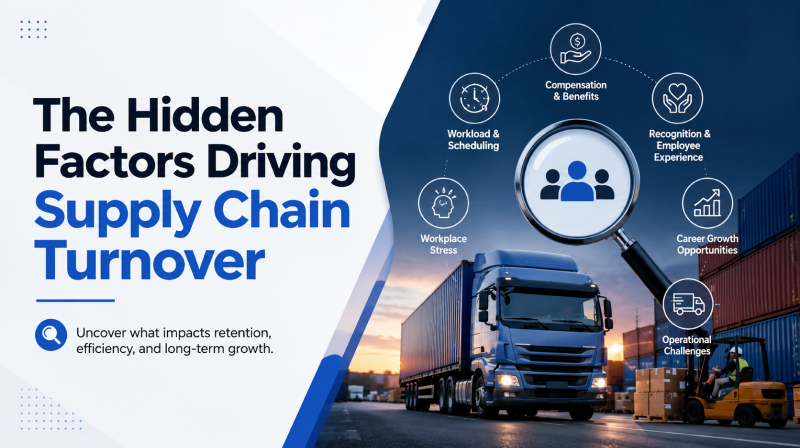
Table of Contents
Supply chain turnover is rarely caused by one obvious problem.
Rising transportation costs, labor shortages, supplier changes, demand volatility, and customer expectations often get the attention. But beneath these visible challenges are operational issues that can quietly create instability across the supply chain.
Poor planning. Limited visibility. Disconnected systems. Inefficient routes. Manual dispatch. Delayed exception management. Inconsistent delivery execution.
Individually, these problems may seem manageable. Collectively, they can create a supply chain that spends more time reacting than optimizing.
That is why understanding the hidden operational factors driving supply chain turnover matters.
The organizations that address these underlying issues can build supply chains that are more connected, predictable, responsive, and easier to scale.
What Is Driving Supply Chain Turnover?
Supply chain turnover can take many forms.
It may appear as frequent changes in carriers or suppliers, inconsistent transportation capacity, fluctuating fulfillment performance, customer churn, operational disruption, or continually changing delivery resources.
Not all turnover can be eliminated. Market conditions will always change.
The bigger concern is avoidable operational instability.
When supply chain processes depend heavily on manual coordination, disconnected data, and reactive decisions, even a relatively small disruption can create problems across multiple stages of the network.
For example:
A delayed vehicle → missed delivery window → customer complaint → additional coordination → higher operating cost → lower network efficiency.
When similar events happen repeatedly, they become more than isolated exceptions. They become structural problems.
1. Poor Planning Creates Problems Before Execution Begins
Many supply chain challenges start before a shipment ever moves.
Planning teams have to balance demand, inventory, delivery windows, vehicle capacity, transportation resources, geographic constraints, and customer requirements.
As networks become more complex, planning these variables manually becomes increasingly difficult.
A plan that looks efficient in the morning can become inefficient by afternoon because of changing demand, traffic, vehicle availability, new orders, cancellations, or unexpected delays.
This is why modern supply chain planning needs to move beyond static schedules.
Dynamic planning and optimisation can help organizations continuously evaluate changing conditions and make better decisions before those changes cascade through the network.
2. Visibility Gaps Make Small Problems Bigger
A supply chain cannot respond effectively to an event it cannot see.
Without real-time visibility, teams may not know:
- Where a shipment is
- Whether a vehicle is running late
- Which deliveries are at risk
- Whether a route is being followed
- Where capacity is being underutilized
- Which customer commitments may be affected
- Where an exception originated
This often forces operations teams to rely on phone calls, emails, spreadsheets, and manual status updates.
The result is a delayed response.
Visibility is therefore not simply a tracking capability. It is the foundation for better decision-making.
Modern delivery orchestration platforms can provide network-wide visibility across fleets, carriers, agents, shipments, and delivery touchpoints, helping organizations move from fragmented information toward a more complete operational picture. nuVizz, for example, positions real-time delivery visibility as a core part of its transportation and delivery orchestration platform.
3. Disconnected Systems Increase Coordination Overhead
A typical supply chain may involve order management systems, ERP platforms, warehouse systems, transportation management systems, fleet applications, carrier systems, customer communication tools, and other technologies.
The technology itself is not necessarily the problem.
The challenge is what happens when these systems do not work together effectively.
Teams may have to move information manually between applications or use multiple screens to understand what is happening.
That creates coordination overhead.
It can also lead to:
- Duplicate data
- Delayed updates
- Inconsistent information
- Manual reconciliation
- Slower decision-making
- Poor exception visibility
This is where supply chain orchestration becomes important.
Instead of optimizing one isolated activity, orchestration connects planning, execution, visibility, and response across the delivery lifecycle.
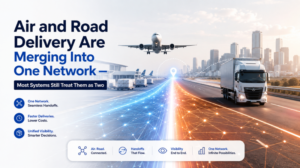
Unify air and road delivery into one connected network.
See How It Works4. Manual Route Planning Does Not Scale With Complexity
Route planning is another hidden source of supply chain inefficiency.
For a small operation with a limited number of deliveries, manual planning may be sufficient.
But enterprise delivery networks can involve hundreds or thousands of orders, multiple vehicles, different customer time windows, capacity constraints, geographic territories, and changing conditions.
The number of variables quickly becomes difficult for humans to process consistently.
Route optimization can evaluate these variables much faster and identify more efficient delivery sequences.
More importantly, dynamic route optimization can respond when conditions change.
A route should not necessarily remain fixed simply because it was optimized earlier in the day.
Modern delivery operations increasingly need routing systems that can react to real-world execution.
nuVizz’s public platform information highlights advanced route optimization alongside mobile dispatch, real-time tracking, cascading ETAs, KPI dashboards, and customer communication—illustrating how routing becomes more valuable when connected to execution and visibility rather than operating as a standalone planning tool.
5. Manual Dispatch Creates an Operational Bottleneck
Dispatch is where plans become actions.
When dispatchers have to manually assign vehicles, drivers, and shipments while simultaneously monitoring exceptions, their workload can grow rapidly as the operation scales.
This creates a difficult situation.
The more complex the network becomes, the more human intervention is required.
But increasing headcount is not always the best answer.
Automation can take over repetitive decisions while allowing operations teams to remain in control of more important exceptions and business decisions.
nuVizz addresses this area through its delivery orchestration capabilities and RoboDispatch, which publicly describes AI-based driver assignment and automated dispatch capabilities designed to help organizations manage delivery resources more efficiently.
6. Poor Exception Management Creates a Chain Reaction
Disruptions are inevitable.
Vehicles break down. Traffic changes. Customers are unavailable. Orders change. Deliveries get delayed. Capacity becomes unavailable.
The problem is not the existence of exceptions.
The problem is how long it takes to detect, understand, and respond to them.
A traditional process might look like this:
Exception occurs → customer calls → dispatcher investigates → team contacts driver → new decision is made → customer is updated.
By the time the process is complete, the disruption may already have affected multiple deliveries.
A more connected operation can identify exceptions earlier, prioritize them, and trigger the appropriate response.
That is one reason exception management is becoming a core capability of modern transportation management and delivery orchestration platforms.
7. Inaccurate ETAs Damage Customer Trust
Customers do not necessarily expect every delivery to be perfectly predictable.
They do expect accurate information.
A customer who receives an accurate ETA can plan around a delivery.
A customer who receives an inaccurate ETA may spend hours waiting, call customer service, or lose confidence in the company.
This makes delivery visibility and ETA accuracy more than operational metrics.
They are part of the customer experience.
Technologies such as real-time tracking, predictive ETAs, automated notifications, and delivery status updates can help organizations provide customers with more timely and useful information.
nuVizz includes real-time tracking, cascading ETAs, customer communication, and delivery visibility within its delivery orchestration capabilities.
8. Poor Vehicle and Capacity Utilization Raises Costs
Supply chain turnover can also be influenced by inefficient resource utilization.
Consider what happens when vehicles regularly operate below capacity or travel unnecessary miles.
The organization may need more vehicles, more drivers, or more transportation capacity to handle the same volume.
At the same time, inefficient routes can increase fuel consumption and operating costs.
This makes vehicle utilization, load planning, route efficiency, and miles driven important supply chain metrics.
nuVizz publicly highlights route optimization and delivery planning capabilities designed to improve asset utilization, reduce miles, and improve delivery efficiency. Its published customer metrics also reference improvements in asset utilization and reductions in manual labor and miles driven.
Actual results, of course, depend on the network, operating model, and implementation.
9. Fragmented Delivery Execution Creates Hidden Costs
A supply chain does not end when a route is planned.
The real test happens during execution.
Drivers need the right information. Dispatchers need visibility. Customers need updates. Operations teams need proof of delivery. Finance teams need accurate billing and settlement information.
If each activity operates independently, organizations can end up with multiple disconnected workflows.
This creates hidden costs through:
- Manual data entry
- Repeated communication
- Paper-based processes
- Delayed proof of delivery
- Billing discrepancies
- Customer service inquiries
- Manual reconciliation
A connected delivery platform can bring these processes into a more unified workflow.
nuVizz’s publicly described capabilities include delivery execution, electronic proof of delivery, document management, billing and settlement, real-time tracking, and network-wide visibility.
10. Reactive Supply Chains Struggle to Scale
Perhaps the biggest hidden factor is the operating model itself.
A reactive supply chain constantly responds to problems.
A proactive supply chain continuously monitors conditions, identifies risks, optimizes decisions, and adapts execution.
The difference can be represented simply:
Reactive model
Problem → Manual investigation → Decision → Action
Proactive model
Data → Visibility → Prediction → Optimization → Action
This is the shift from managing individual transportation activities to orchestrating the delivery network.
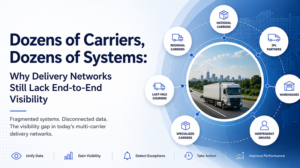
Bring fragmented carriers and systems into one connected view. Get End-to-End VisibilityWhy Supply Chain Orchestration Matters
Supply chain visibility tells you what is happening.
Optimization helps determine what should happen.
Execution makes the decision happen.
Orchestration connects all three.
This distinction is particularly important in last-mile and transportation operations, where conditions can change rapidly.
For example:
A vehicle becomes delayed.
A visibility system identifies the problem.
A routing engine evaluates alternative options.
An orchestration platform can coordinate the resulting change across dispatch, drivers, customers, and other stakeholders.
That creates a closed operational loop rather than another disconnected software workflow.
Where nuVizz Fits
This is the operational gap nuVizz is designed to address.
nuVizz positions itself as a delivery and transportation orchestration SaaS platform, with capabilities spanning route optimization, dispatch, real-time visibility, delivery execution, customer communication, proof of delivery, analytics, and transportation management.
Rather than treating route optimization, tracking, dispatch, and delivery execution as separate problems, the platform brings these capabilities together around the delivery lifecycle.
For organizations managing complex delivery networks, that approach can help connect:
Plan → Optimize → Dispatch → Execute → Track → Respond → Measure
This connected model is particularly relevant for enterprises operating across fleets, carriers, agents, multiple facilities, and complex delivery networks.
nuVizz also describes its platform as supporting multiple supply chain environments, including manufacturers, distributors, retailers, carriers and 3PLs, as well as industries such as automotive parts, food distribution, pharmaceuticals, furniture, and retail.
How Supply Chain Leaders Can Reduce Operational Turnover
Technology is only one part of the solution.
Organizations should first identify where operational instability originates.
Start by asking:
1. Are planning decisions based on real-time information?
If planners are working with outdated information, optimization decisions may already be obsolete when execution begins.
2. Can teams see the entire delivery network?
Visibility should extend beyond individual shipments to fleets, carriers, facilities, routes, and delivery events.
3. How much manual intervention is required?
High levels of manual coordination can indicate opportunities for automation.
4. How quickly are exceptions detected?
The earlier an organization identifies a disruption, the more options it has to respond.
5. Are transportation resources being fully utilized?
Look beyond transportation spend and analyze vehicle utilization, miles driven, capacity, route efficiency, and delivery density.
6. Can planning and execution communicate with each other?
Optimization becomes significantly more valuable when the plan can adapt to what is actually happening in the field.
Turn smarter routing into better driver retention and lower turnover.
Explore Dynamic RoutingThe Future of Supply Chain Management Is More Connected
The future of supply chain management is not simply about adding more software.
It is about connecting the right data, decisions, people, and processes.
Organizations need to move beyond isolated systems that solve individual problems and toward platforms that can coordinate the entire delivery lifecycle.
That means combining:
- Real-time supply chain visibility
- AI-powered route optimization
- Intelligent dispatch
- Dynamic delivery planning
- Predictive ETAs
- Exception management
- Digital proof of delivery
- Customer communication
- Operational analytics
The objective is simple:
Make the supply chain easier to see, easier to manage, and easier to adapt.
Conclusion
Supply chain turnover is often driven by hidden operational inefficiencies such as poor planning, limited visibility, disconnected systems, and reactive execution. Addressing these gaps requires a connected approach to transportation and delivery management. With delivery orchestration capabilities spanning route optimization, dispatch, real-time visibility, and execution, nuVizz helps enterprises build more connected, agile, and predictable delivery operations.
FAQs
The main factors driving supply chain turnover include poor supply chain planning, limited visibility, disconnected systems, inefficient route planning, manual dispatch, weak exception management, and poor transportation utilization. These operational inefficiencies can increase costs, create delays, and make supply chains less predictable.
Poor supply chain visibility makes it difficult to identify shipment delays, delivery exceptions, capacity issues, and other disruptions in real time. Without timely information, teams often rely on manual coordination, which can increase operational costs and create recurring inefficiencies across the supply chain.
Route optimization can reduce supply chain inefficiencies by identifying more efficient delivery sequences based on factors such as vehicle capacity, delivery windows, locations, and changing operational conditions. Dynamic route optimization can also help organizations respond when conditions change during execution.
Supply chain orchestration connects planning, optimization, dispatch, delivery execution, real-time visibility, and exception management into a coordinated workflow. It helps organizations move from reactive decision-making toward a more connected and responsive supply chain operation.
nuVizz helps enterprises improve delivery and transportation operations through capabilities such as route optimization, intelligent dispatch, real-time visibility, delivery execution, exception management, predictive ETAs, and customer communication. By connecting these processes, nuVizz helps organizations build more connected and predictable delivery operations.