Blog
What Most Transportation Management Systems Get Wrong About Last-Mile Delivery
Key Takeaways
- Many Transportation Management Systems (TMS) were originally built for freight planning, not the fast-changing demands of last-mile delivery.
- Static route planning cannot keep up with same-day delivery, dynamic customer requests, and real-time traffic conditions.
- Driver productivity depends on mobile-first tools, yet many legacy TMS platforms still offer limited mobile capabilities.
- Disconnected systems create visibility gaps between dispatch, customer service, finance, and operations.
- Purpose-built last-mile delivery platforms combine routing, dispatch, driver management, proof of delivery, and analytics in one unified ecosystem.
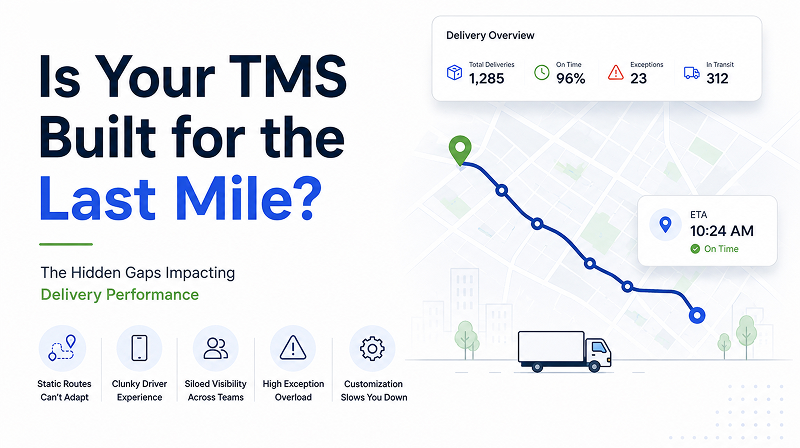
Table of Contents
Last-Mile Delivery Has Changed—Has Your TMS?
For years, Transportation Management Systems (TMS) have helped businesses optimize freight movement, manage carrier relationships, and improve long-haul transportation planning. These systems transformed logistics by making shipment planning, load consolidation, and carrier management more efficient.
However, the logistics landscape has evolved dramatically.
Today’s customers expect same-day deliveries, live order tracking, narrow delivery windows, instant notifications, and flexible delivery options. Businesses are no longer judged solely by how quickly products leave the warehouse—they’re evaluated by how smoothly the final delivery reaches the customer’s doorstep.
This shift has exposed a fundamental challenge.
Many traditional TMS platforms were designed when transportation planning focused primarily on long-haul freight. They excel at optimizing loads, selecting carriers, and planning predictable routes. But the last mile is a completely different operational environment.
Unlike freight transportation, last-mile delivery involves:
- Hundreds or thousands of delivery stops every day
- Constant route adjustments
- Customer schedule changes
- Driver availability fluctuations
- Traffic disruptions
- Failed delivery attempts
- Proof-of-delivery requirements
- Real-time communication
These aren’t occasional exceptions—they’re everyday realities.
As a result, organizations relying solely on traditional TMS software often discover that managing the last mile requires significant manual intervention, disconnected tools, and constant firefighting.
The issue isn’t that traditional TMS platforms are ineffective.
They were simply designed to solve a different logistics problem.
The Biggest Gaps Between Traditional TMS and Last-Mile Operations
Modern last-mile delivery operations demand far more than efficient transportation planning. Businesses need real-time visibility, intelligent route optimization, seamless driver communication, and the flexibility to respond instantly to changing delivery conditions. While many traditional Transportation Management Systems (TMS) excel at freight planning, they often struggle to support the speed and complexity of today’s last-mile environment. Below are the most common gaps that prevent legacy TMS platforms from delivering the agility, visibility, and operational efficiency modern logistics networks require.
1. Static Route Planning Doesn’t Match Dynamic Delivery Networks
Most legacy Transportation Management Systems follow a simple workflow:
- Orders are collected.
- Routes are planned.
- Drivers leave the depot.
- Routes remain mostly unchanged throughout the day.
This approach works reasonably well for freight transportation because shipments generally move between fixed locations with relatively predictable schedules.
Last-mile delivery rarely follows this pattern.
Throughout a single day, operations teams may need to respond to:
- New delivery orders
- Customer rescheduling requests
- Vehicle breakdowns
- Driver call-outs
- Heavy traffic
- Road closures
- Weather disruptions
- Priority deliveries
- Failed delivery attempts
Every one of these events can affect route efficiency.
Without dynamic route optimization, dispatchers are forced to manually adjust schedules using phone calls, spreadsheets, messaging apps, or whiteboards. Instead of relying on automation, operations become dependent on individual dispatcher experience.
Over time, this creates several business challenges:
- Longer delivery routes
- Higher fuel costs
- Increased overtime
- Reduced fleet utilization
- Lower on-time delivery performance
- Dispatcher burnout
A modern last-mile delivery platform continuously analyzes new information throughout the day and automatically recommends—or even executes—route adjustments as conditions change.
Instead of planning once, it optimizes continuously.
Streamline retail logistics from inventory to last-mile delivery with proven best practices.
Read the Complete Guide2. Drivers Need an Operational platform-not just a Mobile App
Drivers are the face of every delivery operation.
They’re responsible for customer interactions, proof of delivery, exception reporting, product handling, and maintaining schedule accuracy. Despite this, many traditional TMS platforms still treat drivers as the final step in the workflow rather than active participants in real-time operations.
In many legacy systems, drivers receive a delivery manifest and little else.
Modern last-mile operations require far more.
Today’s drivers need mobile applications that allow them to:
- View optimized routes
- Receive real-time dispatch updates
- Capture electronic proof of delivery (ePOD)
- Scan barcodes and QR codes
- Upload photos
- Collect digital signatures
- Report delivery exceptions
- Communicate with dispatch instantly
- Access turn-by-turn navigation
- Record delivery notes
When these capabilities are missing—or spread across multiple applications—productivity declines.
The consequences extend beyond driver frustration.
Organizations often experience:
- Longer onboarding times
- More delivery errors
- Increased support calls
- Poor customer communication
- Lower driver satisfaction
- Higher turnover
Considering the ongoing driver shortage affecting logistics providers worldwide, improving the driver experience is no longer just a workforce initiative—it’s a competitive advantage.
Purpose-built last-mile delivery software places drivers at the center of the operation by providing a single mobile interface for every delivery task.
3. Visibility Breaks Down Across Departments
Many organizations assume that implementing a TMS automatically creates end-to-end visibility.
In practice, visibility often remains fragmented.
Dispatch teams may know exactly where drivers are.
Customer service may not.
Finance may rely on different datasets.
Executives may only receive reports after deliveries are complete.
These information silos slow decision-making and increase operational costs.
For example:
- A customer calls asking for an updated ETA.
- Customer service contacts dispatch.
- Dispatch contacts the driver.
- The driver responds several minutes later.
- The customer waits.
Multiply this process across hundreds of deliveries each day, and the operational inefficiencies become significant.
The same issue affects billing, carrier settlements, compliance reporting, and performance analytics.
A modern last-mile platform eliminates these disconnects by creating a single source of operational truth where dispatchers, customer service teams, finance, warehouse staff, and leadership access the same real-time delivery information.
Instead of chasing updates, every stakeholder works from shared, live data.
Customization Isn’t the Same as Purpose-Built Functionality
One of the biggest misconceptions in logistics technology is that any Transportation Management System can support last-mile operations with enough customization.
Technically, that’s often true.
Practically, it’s rarely the most efficient approach.
Many enterprise TMS platforms were designed to solve freight transportation challenges. When organizations expand into home delivery, field service, retail distribution, or B2B last-mile operations, they frequently rely on custom workflows, third-party integrations, or bespoke development to bridge functionality gaps.
Initially, these customizations may appear to solve the problem.
Over time, however, they often introduce new operational complexities.
Common challenges include:
- Lengthy implementation timelines
- Higher deployment and maintenance costs
- Heavy reliance on IT teams or external consultants
- More complex upgrades and version migrations
- Increased technical debt
- Difficulties scaling across regions or business units
The result is a system that technically supports last-mile delivery—but only after significant customization.
As delivery networks grow, every new workflow, customer requirement, or service expansion may require additional configuration, slowing innovation and increasing operational costs.
Purpose-built last-mile delivery platforms take a different approach.
Instead of adapting freight workflows, they are designed around last-mile operations from the outset. Core capabilities such as dynamic dispatch, proof of delivery (POD), driver settlements, dock scheduling, customer notifications, and delivery exception management are built into the platform, reducing the need for extensive customization.
This allows organizations to scale operations without continuously redesigning their technology stack.
Gain real-time shipment visibility and optimize every delivery with a modern logistics platform. Read the GuideException Management Is the Core of Last-Mile Operations
In long-haul transportation, exceptions are relatively infrequent. A delayed shipment, vehicle breakdown, or weather event may require intervention, but these incidents are generally manageable on a case-by-case basis.
Last-mile delivery is different.
Exceptions happen constantly.
On any given day, operations teams may encounter:
- Customers unavailable at delivery
- Incorrect addresses
- Last-minute order changes
- Traffic congestion
- Vehicle breakdowns
- Delivery refusals
- Damaged goods
- Driver delays
- Route deviations
- Failed proof-of-delivery attempts
For fleets managing hundreds or thousands of daily stops, these situations aren’t unusual—they’re part of normal operations.
The issue with many traditional TMS platforms is that they treat exceptions as isolated events requiring manual attention.
Dispatchers must:
- Identify the issue
- Contact the driver
- Determine the next best action
- Notify the customer
- Update delivery records
- Adjust the remaining schedule
Repeat this process dozens—or even hundreds—of times each day, and dispatch teams quickly become overwhelmed.
Modern last-mile delivery software takes a proactive approach.
Instead of simply recording exceptions, it identifies issues in real time, prioritizes them based on business impact, recommends corrective actions, and automates customer communication wherever possible.
This enables dispatchers to focus on critical decisions rather than routine coordination.
AI Is Transforming Last-Mile Execution—Not Just Planning
Artificial intelligence is reshaping logistics, but its role extends far beyond route optimization.
Many legacy TMS platforms use optimization algorithms to generate routes before drivers leave the depot. Once the day begins, however, these routes often remain static unless someone manually intervenes.
Modern last-mile platforms use AI throughout the delivery lifecycle.
AI can continuously evaluate:
- Live traffic conditions
- New customer orders
- Driver availability
- Vehicle capacity
- Delivery priorities
- Service-level agreements (SLAs)
- Historical delivery performance
- Weather conditions
- Customer preferences
Based on these inputs, the system can recommend—or automatically execute—operational adjustments in real time.
Examples include:
- Reassigning deliveries when a driver is delayed
- Re-optimizing routes after a failed delivery
- Predicting late deliveries before they occur
- Balancing workloads across drivers
- Suggesting the most efficient delivery sequence
- Improving estimated arrival times (ETAs)
The value of AI isn’t replacing dispatchers.
It’s helping them make faster, better-informed decisions while reducing manual effort and improving service consistency.
Traditional Transportation Management System vs. Purpose-Built Last-Mile Platform
| Capability | Traditional TMS | Purpose-Built Last-Mile Platform |
| Primary Focus | Freight planning and carrier management | End-to-end last-mile execution |
| Route Planning | Static, batch-based | Dynamic, real-time optimization |
| Dispatch | Manual adjustments | AI-assisted dynamic dispatch |
| Driver Experience | Basic mobile support | Mobile-first driver workflow |
| Proof of Delivery | Often requires additional modules | Built-in digital POD |
| Customer Visibility | Limited | Real-time tracking and notifications |
| Exception Management | Manual | Automated detection and resolution workflows |
| Scalability | Requires extensive customization | Designed for high-volume delivery operations |
| Analytics | Historical reporting | Live operational dashboards and predictive insights |
This comparison doesn’t suggest that traditional TMS platforms lack value.
They remain highly effective for freight transportation, carrier management, and long-haul logistics.
The challenge arises when businesses expect freight-centric systems to support the speed, flexibility, and customer expectations of modern last-mile delivery without purpose-built capabilities.
Why Legacy TMS Architecture Struggles to Scale
Many logistics organizations don’t notice these limitations during the early stages of growth.
A fleet with 20 drivers and a few hundred daily deliveries may successfully manage operations through a combination of TMS software, spreadsheets, emails, and dispatcher expertise.
As the business grows, however, complexity increases rapidly.
Organizations begin adding:
- New distribution centers
- Regional delivery hubs
- Additional carriers
- Contract drivers
- Multiple delivery windows
- Diverse service offerings
- Same-day and next-day delivery
- Reverse logistics
- White-glove services
- Customer-specific SLAs
Each addition increases the volume of data, decisions, and coordination required.
When core processes depend on manual intervention or disconnected systems, scaling becomes increasingly difficult.
Instead of improving efficiency, growth can introduce operational bottlenecks, inconsistent service quality, and rising costs.
Purpose-built last-mile platforms are designed with this complexity in mind, providing the flexibility and automation needed to support expanding delivery networks without relying on workarounds.
Learn how AI-powered auto dispatch improves routing, scheduling, and driver assignment in real time.
Explore the BlogWhy This Gap Still Exists
The shortcomings of many traditional Transportation Management Systems aren’t necessarily the result of poor technology—they’re a reflection of how logistics has evolved.
When many TMS platforms were introduced, their primary objective was to help businesses move freight efficiently across long distances. Success was measured by optimizing loads, selecting the right carriers, and reducing transportation costs.
Today’s logistics environment looks very different.
Customers expect:
- Same-day and next-day delivery
- Accurate ETAs
- Live shipment tracking
- Flexible delivery windows
- Instant delivery notifications
- Seamless delivery experiences
At the same time, logistics providers are managing larger fleets, tighter service-level agreements (SLAs), and more frequent delivery exceptions than ever before.
In this environment, execution has become just as important as planning.
A system that excels at transportation planning but lacks real-time operational capabilities can leave dispatchers, drivers, and customer service teams filling the gaps through manual processes.
The technology hasn’t necessarily failed—it’s simply being asked to solve problems it wasn’t originally designed to address.
What Modern Last-Mile Leaders Do Differently
Organizations that consistently achieve high on-time delivery rates, lower operational costs, and better customer experiences tend to share a common approach.
Rather than treating the last mile as an extension of freight transportation, they manage it as a distinct operational discipline with its own technology requirements.
Modern last-mile leaders invest in platforms that provide:
1. Real-Time Dynamic Dispatch
Routes are continuously optimized throughout the day based on traffic, delivery priorities, driver availability, and new orders, enabling operations to adapt as conditions change.
2. Mobile-First Driver Experience
Drivers use intuitive mobile applications to manage navigation, proof of delivery, barcode scanning, customer communication, and exception reporting from a single interface.
3. Unified Operational Visibility
Dispatch, customer service, warehouse teams, finance, and leadership work from the same real-time operational data, improving collaboration and reducing delays.
4. Automated Exception Management
Potential issues are detected early, prioritized automatically, and routed to the appropriate teams, allowing dispatchers to focus on resolving critical events rather than monitoring every delivery manually.
5. AI-Powered Decision Support
Artificial intelligence analyzes live operational data to improve routing, predict delays, optimize fleet utilization, and help dispatchers make faster, more informed decisions.
Together, these capabilities create a more resilient and scalable delivery operation—one that’s better equipped to meet evolving customer expectations.
Choosing the Right Platform for Modern Last-Mile Delivery
Selecting a transportation platform shouldn’t be based solely on feature checklists.
The more important question is whether the platform aligns with the realities of your delivery operation.
If your teams regularly rely on spreadsheets, phone calls, manual route adjustments, or disconnected systems to manage daily deliveries, it may indicate that your current technology is compensating for architectural limitations.
When evaluating solutions, consider whether the platform can support:
- Continuous route optimization throughout the day
- AI-assisted dispatch and planning
- Mobile-first workflows for drivers
- Digital proof of delivery (ePOD)
- Real-time shipment visibility
- Automated customer notifications
- Driver settlement and performance management
- Delivery analytics and operational dashboards
- Seamless integrations with ERP, WMS, CRM, and eCommerce platforms
- Scalability across multiple regions, fleets, and business units
A platform designed around these capabilities is more likely to support long-term operational growth than one requiring extensive customization to achieve the same outcomes.
Discover how generative AI helps enterprise fleets optimize routes and improve last-mile efficiency. Read the GuideHow Purpose-Built Platforms Like nuVizz Bridge the Gap
As last-mile delivery becomes increasingly dynamic, many organizations are adopting platforms built specifically for execution rather than adapting freight-centric systems.
Solutions like nuVizz are designed around the operational realities of modern last-mile logistics, combining capabilities such as AI-powered route optimization, dynamic dispatch, driver mobile applications, digital proof of delivery, customer visibility, carrier management, and real-time analytics within a unified platform.
Rather than relying on multiple disconnected tools, businesses can manage planning, execution, visibility, and performance from a single ecosystem.
For enterprises operating high-volume delivery networks, this integrated approach helps improve efficiency, reduce manual intervention, and enhance the overall customer experience while supporting future growth.
Final Thoughts
Transportation Management Systems remain essential to modern logistics.
For freight transportation, carrier procurement, and shipment planning, they continue to deliver significant value.
However, last-mile delivery introduces a different set of operational challenges—ones defined by real-time decision-making, continuous route optimization, customer communication, mobile workforce management, and high-frequency exceptions.
As customer expectations continue to rise, organizations need technology that supports both strategic transportation planning and operational execution.
For many businesses, the next stage of logistics transformation isn’t replacing the TMS—it’s complementing or extending it with a purpose-built last-mile delivery platform capable of handling the speed, complexity, and visibility demands of today’s delivery networks.
The organizations that recognize this distinction will be better positioned to improve operational efficiency, enhance customer satisfaction, and scale confidently in an increasingly competitive logistics landscape.
Ready to transform your last-mile operations? Book a demo and see how nuVizz helps optimize every delivery.
FAQs
Traditional TMS platforms were primarily designed for freight planning, carrier management, and long-haul transportation. Last-mile delivery requires real-time route optimization, dynamic dispatch, mobile-first driver tools, and continuous exception management—capabilities that many freight-centric systems weren't originally built to provide.
A traditional TMS focuses on transportation planning, freight movement, carrier selection, and shipment optimization. Last-mile delivery software is designed for delivery execution, including dynamic routing, driver management, proof of delivery, customer notifications, real-time visibility, and delivery exception handling.
Many TMS platforms can support last-mile workflows through customization and third-party integrations. However, organizations with high-volume or complex delivery operations often benefit from purpose-built last-mile platforms that offer these capabilities natively.
Key capabilities include:
- AI-powered route optimization
- Dynamic dispatch
- Driver mobile applications
- Electronic proof of delivery (ePOD)
- Real-time delivery tracking
- Automated customer notifications
- Exception management
- Fleet performance analytics
- Integration with ERP, WMS, CRM, and TMS systems
Not necessarily.Many organizations continue using their existing Transportation Management System for freight planning and carrier management while integrating a dedicated last-mile delivery platform for execution, visibility, and customer experience. This approach allows businesses to enhance last-mile capabilities without replacing their core transportation infrastructure.