Blog
Your Dispatchers Are Spending 60 Minutes Every Morning on a Problem Software Solves in 60 Seconds
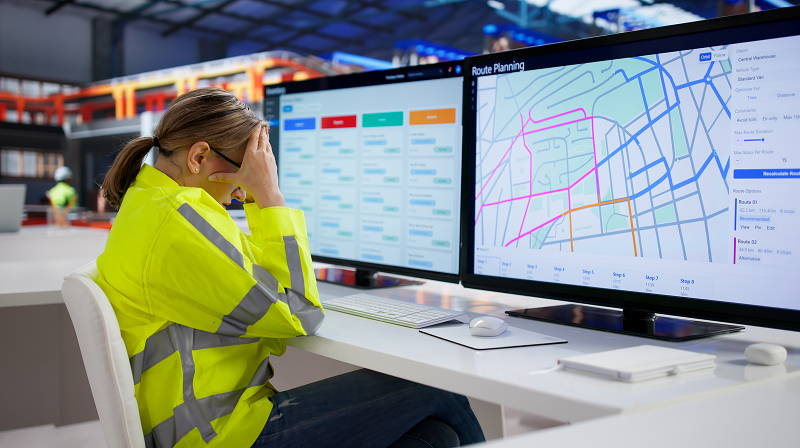
Every morning, before the first delivery truck rolls out of your yard, something costly is already happening inside your dispatch office.
A dispatcher — perhaps your best one — is hunched over a screen or shuffling printed manifests, manually sorting through yesterday’s incomplete deliveries, cross-referencing new orders, adjusting routes for driver availability, recalculating stop sequences, and trying to answer the same question that greets them every single day: Who goes where, and in what order?
This ritual can easily consume 45 to 60 minutes. Every morning. For every dispatcher on your team.
The painful irony? A modern Last Mile Delivery TMS can produce the same output — fully optimized, constraint-aware, driver-assigned routes — in under 60 seconds.
This is not a marginal efficiency gap. It is a fundamental operational fault line that separates high-performing last mile operations from those that are perpetually fighting fires before noon.
The Real Cost of the Morning Dispatch Ritual
Before dismissing this as an unavoidable cost of doing business, consider the full math.
Assume your dispatching team spends an average of 60 minutes each morning preparing routes manually. If you have three dispatchers, that is three hours of skilled labor consumed before a single delivery begins. Over a 250-day working year, that accumulates to 750 hours of dispatcher time — roughly 18 full workweeks — spent on a task that automation handles instantly.
But the direct labor cost is just the beginning. Manual dispatch planning introduces a cascade of downstream consequences:
Late planning means late departures
When routes aren’t finalized until 7:30 or 8 AM, drivers wait. Departure windows tighten. The entire day’s delivery schedule compresses, leaving no buffer for real-world variables like traffic, customer unavailability, or vehicle issues.
Human planning cannot optimize at scale
A skilled dispatcher managing 20 to 30 stops can apply reasonable logic to sequencing. But when the stop count climbs to 80, 120, or 200 per vehicle or across a fleet, the cognitive complexity exceeds human capacity. Manual routing at this scale means your routes aren’t optimized — they’re approximated. That approximation costs fuel, time, and on-time delivery performance.
Inconsistency compounds the problem
Dispatcher A might prioritize geography. Dispatcher B might sequence around time windows. Dispatcher C might favor customer preference or driver familiarity. Without a consistent optimization engine, route quality varies day to day, driver to driver. You can’t measure what you can’t standardize.
Manual dispatch is fragile
If your best dispatcher calls in sick, who replicates their decision-making? Institutional knowledge locked inside one person’s head is an operational liability, not a competitive advantage.
Most logistics teams are using AI the wrong way—are you one of them?
Find Out NowWhat Dispatchers Are Actually Doing During That Hour
To understand why this problem is so persistent, it helps to map out what manual morning dispatch actually involves. Most operations require dispatchers to work through some version of the following workflow:
- Review overnight order imports — Identifying new deliveries, changes to existing orders, and cancellations
- Check driver availability — Accounting for absences, late starts, restricted licenses, or vehicle assignments
- Account for failed deliveries from prior days — Determining which stops need to be re-attempted and with what priority
- Apply time-window constraints — Manually identifying which customers require delivery within specific windows
- Assign vehicles to routes — Matching load weight and volume against vehicle capacity
- Sequence stops — Building a logical geographic and time-sensitive order for each route
- Check for regulatory compliance — Hours-of-service limits, break requirements, and driver certification constraints
- Communicate assignments — Printing, emailing, or calling each driver with their route details
Every one of these steps involves judgment, cross-referencing, and iteration. Miss a constraint, and you don’t find out until a driver calls from the field. Change one variable — a late driver, a priority insertion, a vehicle going to maintenance — and the entire plan may need to be rebuilt from scratch.
This is the dispatcher’s morning. And it is a problem that was solved by software years ago.
How a Last Mile TMS Solves This in 60 Seconds
A purpose-built Last Mile Delivery TMS doesn’t approximate the morning dispatch problem — it eliminates it through automated, constraint-aware optimization that processes all relevant variables simultaneously.
Here is what happens when intelligent TMS technology takes over the planning function:
Automated order ingestion and processing
Modern last mile platforms connect directly to your order management system, ERP, or e-commerce platform. By the time your dispatcher arrives at the office, all new orders are already loaded, validated, and geocoded. There is no manual import step, no cross-referencing between systems, no manual data entry.
Intelligent route optimization
The route optimization engine evaluates every stop, every driver, every vehicle, and every constraint — simultaneously. It considers delivery time windows, customer preferences, vehicle load capacity, driver availability, geographic clustering, traffic patterns, and regulatory requirements. In seconds, it produces route plans that would take a human dispatcher an hour to approximate — and the automated output is mathematically superior in nearly every case.
Dynamic exception handling
A driver calls in sick at 6:30 AM? The system rebalances assignments across the remaining available drivers automatically. A priority order is inserted at 7:00 AM? It is slotted into the appropriate route based on geography and time windows without disrupting the rest of the plan. Changes that previously forced a dispatcher to rebuild a route from scratch now resolve in moments.
Digital dispatch and communication
Once routes are generated, assignments are pushed directly to driver mobile apps. Drivers receive turn-by-turn navigation, stop-by-stop delivery instructions, proof-of-delivery capture capability, and real-time updates — all without a dispatcher manually communicating each assignment.
Audit trail and standardization
Every dispatch decision is recorded, timestamped, and reportable. Route quality becomes consistent, measurable, and improvable over time. The institutional knowledge is no longer locked in a dispatcher’s head — it is encoded in the system’s optimization logic.
The result: what took 60 minutes of skilled human effort now happens in less than 60 seconds, with better output quality and zero dependency on individual dispatcher expertise.
Want smarter cost control without cutting your workforce? Explore StrategiesThe Strategic Implications for Your Last Mile Operation
Reclaiming that morning hour has compounding benefits that extend far beyond the time saved.
Dispatchers shift from reactive to strategic
When the morning planning burden is removed, your dispatchers become available for higher-value work: managing exceptions in real time, communicating proactively with customers, analyzing performance trends, and supporting drivers in the field. You didn’t hire experienced dispatch professionals to manually sort stops — you hired them to exercise judgment and manage complexity. Give them that opportunity.
Earlier departure windows improve delivery performance
When routes are ready at 5:30 AM instead of 8:00 AM, drivers can depart earlier and reach customers before peak traffic. Time-sensitive deliveries hit their windows more consistently. Customer satisfaction improves, and failed delivery rates decline.
Scalability becomes achievable
One of the hardest things about growing a last mile operation is that volume growth translates directly into dispatch complexity. More orders mean more routes, more constraints, more variables. Manual dispatch doesn’t scale — it bottlenecks. A TMS scales effortlessly, handling 500 stops with the same speed and consistency it handles 50. Growth stops requiring proportional headcount increases in dispatch.
Data enables continuous improvement
With every route and dispatch decision captured in the system, you gain access to performance analytics that simply don’t exist in manual operations. Which routes consistently run over time? Which drivers outperform their planned routes? Which customer locations generate disproportionate delivery failures? This data drives operational improvement over time, transforming your last mile from a cost center into a competitive differentiator.
Why the Problem Persists in So Many Operations
If the solution is this clear, why are so many last mile operations still running manual dispatch processes?
The honest answer involves a combination of organizational inertia, underestimated technology maturity, and the “it works well enough” trap.
Manual dispatch feels manageable when volume is low. Experienced dispatchers develop routines and heuristics that work reasonably well for a stable set of routes. The pain only becomes visible when volume spikes, when a key dispatcher leaves, or when a competitor begins outperforming you on delivery speed and reliability.
By the time organizations recognize the problem, they’ve often spent years with a significant competitive disadvantage locked into their morning routine.
The technology barrier that once made TMS adoption difficult for mid-size and growing operations has also largely disappeared. Platforms like the nuVizz Last Mile Delivery TMS are designed for operational accessibility — intuitive interfaces, rapid implementation, flexible integration with existing systems, and scalable pricing that makes ROI achievable for operations of all sizes.
The question facing logistics and fleet operations leaders today is no longer whether automation can solve the morning dispatch problem. It clearly can. The question is how long you can afford to pay the daily cost of not solving it.
Scale delivery performance without scaling your fleet size.
Improve NowEvaluating Your Current Dispatch Operation
If you’re assessing whether your operation has this problem, consider the following diagnostic questions:
- How long does your dispatch team spend building routes each morning on average?
- What happens to your dispatch timeline when a driver or vehicle is unavailable at the last minute?
- Do route quality and sequencing vary depending on which dispatcher is on duty?
- How much manual communication occurs between dispatch and drivers at the start of each shift?
- Do you have visibility into route optimization quality — or do you simply trust that routes are “good enough”?
- Has dispatch staffing grown in proportion to delivery volume growth?
If several of these questions surface uncomfortable answers, you are almost certainly operating with a dispatch process that is costing you measurably in time, fuel, labor, and delivery performance — every single day.
The Case for Acting Now
In last mile logistics, margins are thin and customer expectations are not declining. Amazon and the large-scale e-commerce delivery ecosystem have permanently reset consumer expectations around delivery speed, visibility, and reliability. Every logistics operation competing in this environment — whether delivering medical supplies, building materials, furniture, or retail goods — is being measured against a standard set by operations running sophisticated automation.
Manual dispatch is not a neutral choice. It is a structural disadvantage that compounds with every passing day, every missed delivery window, every hour your dispatchers spend on tasks that software handles in seconds.
The 60-minute morning ritual your dispatchers are running right now is not just an inefficiency. It is an indicator that your operation is carrying unnecessary cost and risk in a function where proven, accessible technology has already solved the problem.
Modern last mile TMS platforms have made optimized, automated dispatch available to operations of every scale. The question is simply when you choose to close the gap.
Conclusion
Dispatch automation is one of the clearest, most measurable ROI opportunities available to last mile logistics operations today. The time savings are immediate. The route quality improvements are quantifiable. The downstream benefits — better on-time performance, reduced fuel consumption, scalable operations, empowered dispatch teams — are real and significant.
Your dispatchers are talented professionals. The problem they’re solving every morning is a legitimate operational challenge. But it is a challenge that modern technology has already solved — efficiently, accurately, and in a fraction of the time.
If your operation is still investing 60 minutes in a problem that software solves in 60 seconds, the ROI case for change has never been stronger.
Ready to automate your morning dispatch? Book a Free nuVizz Demo Today.
FAQs
On average, dispatchers spend between 45 to 60 minutes every morning manually building routes — reviewing orders, checking driver availability, sequencing stops, applying time-window constraints, and communicating assignments. For a team of three dispatchers, this amounts to over 750 hours of skilled labor consumed per year on a task that a Last Mile Delivery TMS automates in under 60 seconds.
A Last Mile Delivery TMS (Transportation Management System) is software specifically designed to automate and optimize the final leg of a delivery journey — from the distribution hub to the end customer. For dispatchers, it eliminates the manual morning planning process by automatically ingesting orders, optimizing routes based on real-world constraints (time windows, vehicle capacity, driver availability, traffic), and pushing assignments directly to driver mobile apps — all without manual intervention.
Route optimization software reduces dispatcher workload by automating the most time-intensive steps of dispatch planning: order sorting, stop sequencing, constraint matching, vehicle-load balancing, and driver assignment. Instead of manually building routes over 45–60 minutes, dispatchers review and approve system-generated, optimized routes in minutes. This frees dispatcher time for higher-value tasks like real-time exception handling, driver support, and customer communication.
Yes — and with greater accuracy. While an experienced dispatcher can apply reasonable logic to 20–30 stops, a Last Mile TMS evaluates hundreds of stops, vehicles, drivers, and constraints simultaneously using advanced optimization algorithms. It produces mathematically superior route plans in seconds, accounting for variables — like live traffic, hours-of-service limits, or multi-stop time windows — that are difficult for humans to process manually at scale.
Manual dispatch does not scale efficiently. As order volume grows, the complexity of stop sequencing, constraint management, and route balancing increases exponentially — not linearly. What a dispatcher manages reasonably at 30 stops per day becomes unmanageable at 100 or 200 stops. Without automation, growing operations are forced to hire additional dispatchers just to maintain service levels. A Last Mile TMS handles increased volume with the same speed and accuracy regardless of scale, making it a critical enabler of operational growth.
The nuVizz Last Mile Delivery TMS automates the entire morning dispatch workflow — from order ingestion and geocoding to route optimization, driver assignment, and mobile dispatch. The platform's optimization engine processes all delivery constraints simultaneously, producing optimized routes in seconds. Dispatchers gain a real-time operations dashboard, drivers receive assignments on their mobile app with turn-by-turn navigation, and operations leaders get full visibility into fleet performance. The result is a faster, more consistent, and more scalable dispatch process from day one.