Blog
Role of AI in Improving Last Mile Delivery
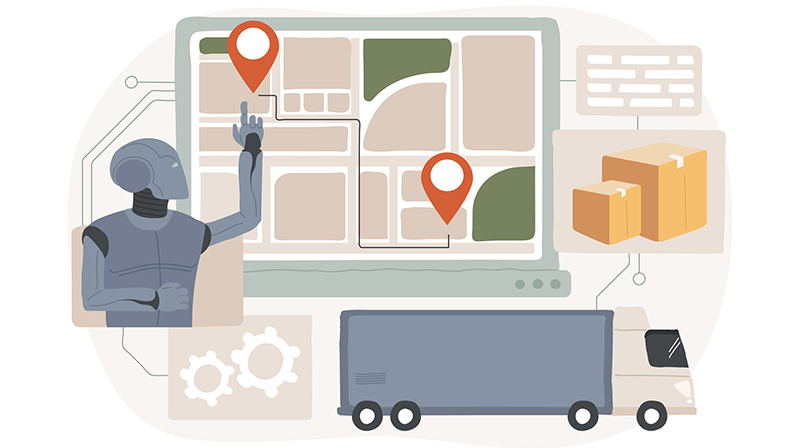
Table of Contents
Last-mile delivery remains the toughest part of the supply chain—accounting for up to 53–60% of total logistics costs. And with consumer expectations soaring for speed, transparency, and sustainability, businesses must innovate—or risk falling behind.
This is where AI steps in. From real-time route optimization to predictive dispatch and autonomous robotics, AI is reshaping how goods reach doorsteps—delivering cost savings, happier customers, and a greener footprint.
Why AI Matters for Last-Mile Efficiency
AI is no longer a “nice-to-have” for logistics companies—it’s an operational necessity. It addresses three core pain points of last-mile delivery: high costs, time inefficiencies, and inconsistent customer experiences. By processing vast data sets in real time, AI enables decisions and actions that humans alone cannot match in speed or accuracy.
Cutting costs and boosting speed
AI-powered solutions reduce last-mile logistics costs by as much as 20–40% and improve delivery times by up to 22%.
Better success rates, fewer delays
Predictive AI can decrease delivery delays by 14–30%, while smart tracking improves accuracy to nearly 99.9%.
Customer satisfaction and retention
With AI-powered tracking and dynamic updates, satisfaction scores rise by 18–25%, and on-time delivery rates hit 95% or more.
Overwhelmed by manual dispatch decisions and wasted fleets?
Automate dispatch today5 Key AI Applications Transforming the Last Mile
AI’s power is best understood through its real-world applications. From intelligent route planning to fully autonomous delivery robots, these innovations are becoming everyday operational tools for logistics providers worldwide.
Dynamic Route Optimization
AI continuously assesses traffic, weather, delivery windows, and vehicle availability to adjust routes on the fly—yielding 20–30% shorter delivery times and a 10% reduction in operating costs.
nuVizz’s AI-routing module integrates seamlessly with fleet systems to automate this process in real time.
Predictive Analytics & Demand Forecasting
By analyzing historical order patterns, seasonal fluctuations, and local events, AI can forecast demand accurately—allowing inventory to be positioned closer to customers and cutting down fulfillment time.
Autonomous Delivery — Robots & Drones
Autonomous delivery systems are no longer futuristic concepts—they’re active participants in modern logistics networks. Using AI for navigation, obstacle detection, and scheduling, these systems can operate with remarkable accuracy and efficiency, reducing both labor dependency and operational costs.
- Road and sidewalk bots: Companies like Serve Robotics deploy autonomous delivery robots with 99.8% operational efficiency, outperforming humans in precision and uptime.
- AI-guided drones: Micro-fulfillment drones are reducing delivery times and easing urban congestion, making ultra-fast delivery more viable.
Smart Micros + Urban Fulfillment Hubs
AI supports micro-fulfillment centers and smart lockers, strategically placing goods closer to recipients—reducing both travel distance and delivery costs.
Sustainability Gains
With optimized routing and autonomous fleets, AI can reduce fuel usage and carbon emissions by up to 18–25%, supporting corporate sustainability goals.
Tired of misdeliveries and manual dispatch hassle? Automate with AIReal-World Next-Gen Examples
Understanding how AI works in practice helps separate hype from reality. Here are some standout examples showing measurable gains:
- UniUni: Leveraging AI and a crowdsourced driver model, UniUni cut Shein’s delivery times from 10–14 days to just 4–5 days.
- Amazon’s Tech Edge: Amazon uses agentic AI for warehouse robots, generative AI for mapping, and AI-powered driver eyewear to improve last-mile speed and accuracy.
- Serve Robotics: Expanded to multiple U.S. cities, achieving 99.8% efficiency and a 350% year-over-year increase in active robot hours.
Challenges & Considerations
While AI offers major benefits, its implementation isn’t without hurdles. Companies must address technical, regulatory, and cultural barriers before reaping full value.
Regulatory Hurdles and Safety
Autonomous systems and drones face region-specific legal challenges.
Integration Complexity
Older, rigid logistics systems can slow AI adoption—flexible, modular platforms are key.
Customer Trust & Experience
Transparency and communication are critical to building acceptance of AI-driven delivery.
nuVizz helps organizations overcome these challenges with compliance-ready models, smooth system integrations, and customer-first AI deployment.
Lost without real-time visibility into deliveries?
Unlock live tracking nowFuture Outlook: 2025 and Beyond
The next phase of AI in last-mile delivery will be even more transformative. Expect a shift from reactive logistics to proactive, predictive systems that anticipate demand, prevent disruptions, and optimize sustainability.
Humanoid delivery robots
Amazon’s prototypes running from Rivian EVs signal hybrid, human-assisted automation.
AI-powered micro-fulfillment hubs
These will proliferate to enable same-day and next-day delivery on a wider scale.
Predictive, proactive logistics
AI will increasingly drive anticipatory operations—automating responses before problems occur.
Conclusion
AI is not just shaping the future of last-mile delivery—it’s redefining what’s possible today. With the right technology partner, logistics providers can cut costs, speed up deliveries, and meet ambitious sustainability goals without compromising customer satisfaction.
At nuVizz, we design AI-driven solutions—from real-time dynamic routing to predictive forecasting and autonomous delivery integration—that help businesses stay ahead in a fast-changing logistics landscape.
Ready to bring AI into your last-mile operations? Contact us to start your transformation.
FAQs
AI in last-mile delivery refers to the use of artificial intelligence technologies—such as machine learning, predictive analytics, and automation—to improve the efficiency, speed, and accuracy of delivering goods from a distribution hub to the customer’s doorstep.
AI uses real-time data on traffic, weather, delivery windows, and driver availability to automatically create and adjust routes. This results in faster delivery times, reduced fuel consumption, and fewer failed delivery attempts.
Yes. Cloud-based AI delivery platforms make these tools accessible to small and mid-sized businesses without requiring heavy infrastructure investment. Many solutions can be scaled as the business grows.
Challenges include integration with existing systems, regulatory constraints for autonomous vehicles or drones, data privacy concerns, and initial investment costs.
The future will bring more predictive, proactive logistics—where AI anticipates demand and problems before they occur. Expect greater use of humanoid robots, AI-powered micro-fulfillment hubs, and greener, fully autonomous fleets.