Blog
Ecommerce Delivery Software: How to Choose the Right Platform
Key Takeaways
- E-commerce delivery software helps businesses manage routing, dispatch, tracking, delivery execution, and related workflows from a connected platform.
- Delivery orchestration extends beyond basic fleet management by coordinating multi-hub, multi-carrier, 3PL, and last-mile delivery operations.
- AI-powered dynamic routing can continuously optimize routes based on traffic, order volumes, vehicle capacity, driver availability, and delivery windows.
- Real-time visibility and predictive ETAs help operations teams monitor deliveries, manage exceptions, and keep customers informed throughout the delivery journey.
- Integration, mobile usability, and scalability are key factors to evaluate when selecting delivery software for a growing e-commerce operation.
- TCO and ROI analysis should consider software and implementation costs alongside potential operational improvements in fleet utilization, customer service, re-deliveries, and financial workflows.
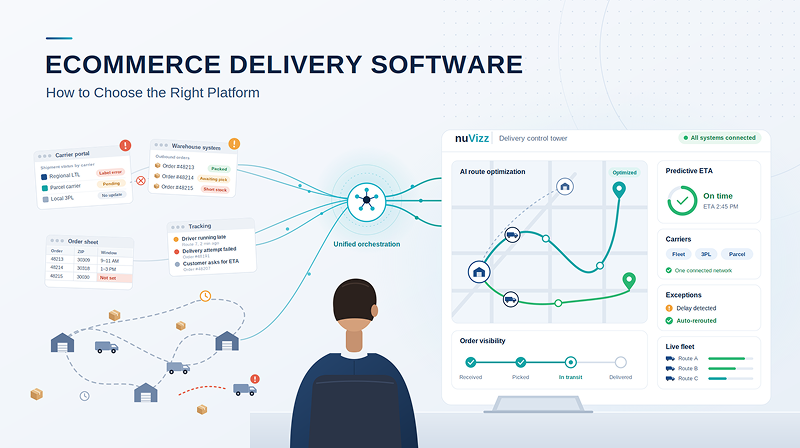
Table of Contents
E-commerce logistics has evolved from a back-office function into a key factor influencing customer experience, retention, and operating efficiency. Today’s online shoppers increasingly expect narrow delivery windows, accurate arrival estimates, and visibility from checkout to doorstep. Meeting these expectations while protecting profit margins requires logistics leaders to move beyond fragmented, manual processes and invest in the right e-commerce delivery software.
Selecting the right platform is rarely straightforward. From basic point-to-point route planners to enterprise-grade transportation management systems (TMS), available solutions vary significantly in capabilities, scalability, integrations, and network coverage. Decision-makers need to evaluate their delivery network, carrier ecosystem, operational workflows, and technology requirements before choosing a platform.
This blog explains the key capabilities, evaluation criteria, and strategic considerations to help businesses choose an e-commerce delivery software platform that supports operational efficiency, improves delivery visibility, and scales with long-term business needs.
Understanding Delivery Management vs. Delivery Orchestration
Before evaluating software vendors, it is important to understand the difference between delivery management software and delivery orchestration platforms. While both can support delivery execution, they differ in scope, connectivity, and the level of coordination they provide across a delivery network.
Delivery Management Software
Typically focuses on day-to-day delivery execution within a specific fleet, team, or operational unit. Common capabilities include route planning, dispatching, driver management, delivery tracking, and status updates.
Delivery Orchestration Platforms
Extend beyond individual fleet execution by connecting multiple parts of the delivery network, including private fleets, regional carriers, 3PLs, cross-docks, and distribution centers. Depending on the platform, capabilities may include dynamic planning, automated dispatching, predictive ETAs, exception management, electronic proof of delivery (ePOD), and settlement workflows within a connected execution environment.
For businesses managing multi-hub operations or multi-carrier delivery networks, delivery orchestration can provide a broader execution layer that connects distributed operations, improves end-to-end visibility, and helps coordinate delivery workflows across multiple stakeholders.
6 Essential Capabilities to Evaluate in E-commerce Delivery Software
Choosing e-commerce delivery software requires more than comparing basic routing and tracking features. Businesses should evaluate how well a platform can optimize delivery operations, connect multiple carriers, improve visibility, and automate workflows from planning through settlement.
1. AI-Powered Dynamic Routing & Optimization
Static route planning can be limiting for fast-paced e-commerce operations, particularly when order volumes, traffic conditions, delivery windows, or fleet availability change throughout the day. Modern platforms can use artificial intelligence (AI) and machine learning to analyze variables such as traffic conditions, order volumes, driver schedules, vehicle capacities, and customer delivery windows.
Key benefits of AI-driven optimization include:
- Reduced Mileage & Fuel Consumption: Optimizing routes and minimizing unnecessary travel can help reduce fuel consumption, operating costs, and associated emissions.
- Dynamic Re-planning: Automatically adjusting routes when real-time disruptions, such as traffic delays, missed stops, or vehicle breakdowns, affect the original plan.
- Increased Delivery Density: Optimizing stop sequences and vehicle utilization can help drivers complete more deliveries within available shift and service constraints.
2. End-to-End Real-Time Visibility
Managing delivery orders across multiple facilities, distribution hubs, and third-party carriers can create visibility gaps. E-commerce delivery software should provide a unified view of delivery operations, aggregating shipment and milestone data from dispatch through final delivery.
This visibility helps operations and customer service teams monitor delivery progress, identify exceptions, and respond to issues before they create a larger impact on the customer experience.
Discover the tools that make shipment tracking simpler and more transparent.
Explore Shipment Tracking Tools3. Multi-Carrier and 3PL Network Orchestration
Many scaling e-commerce businesses use a hybrid delivery model that combines internal fleets, dedicated couriers, regional carriers, and third-party logistics (3PL) partners. The software should support multi-carrier operations through capabilities such as:
- Centralized Carrier Assignment: Assigning orders to appropriate carriers, fleets, or delivery partners based on operational requirements.
- Automated Load Dispatching: Streamlining the process of assigning delivery orders and loads to available resources.
- Unified Status Tracking: Standardizing delivery milestones and tracking information across different carrier networks.
- SLA Monitoring: Monitoring service-level agreements (SLAs) and identifying exceptions across carriers and delivery partners.
4. Predictive ETAs and Customer Communication
Uncertainty around delivery arrival times can increase customer inquiries and create additional pressure on customer service teams. Delivery platforms with predictive ETA capabilities can use real-time and historical data to estimate arrival times and continuously update them as delivery conditions change.
Automated SMS and email notifications can keep customers informed at key delivery milestones, helping businesses improve communication, manage expectations, and reduce delivery-related friction.
5. Digital & Contactless Proof of Delivery (ePOD)
Paper delivery receipts can slow down administrative workflows and make it harder to verify completed deliveries. Look for driver mobile applications that support comprehensive electronic proof of delivery (ePOD) capabilities, including:
- Photo Verification & Barcode Scanning: Capturing delivery evidence and scanning relevant items or packages at pickup and drop-off.
- Digital Signature Capture: Supporting electronic signatures and contactless confirmation options where required.
- Geostamping & Timestamping: Automatically recording location and time information associated with delivery events.
These digital records can also provide operational teams with faster access to delivery documentation for customer service, billing, and dispute resolution.
6. Automated Financial Settlement & Billing
Delivery software should extend beyond physical execution to support financial reconciliation. Platforms with integrated settlement capabilities can help automate rate management, carrier payment calculations, driver compensation, and billing adjustments.
Connecting operational execution data with financial workflows can reduce manual administrative work, improve reconciliation, and help minimize billing discrepancies.
Step-by-Step Evaluation Framework for Buyers
When selecting e-commerce delivery software, use a structured evaluation framework to connect platform capabilities with your operational requirements, technology environment, and expected business outcomes.
1. Audit Network Complexity
Start by mapping your delivery operation. Determine whether your business primarily needs single-fleet delivery management or requires multi-carrier, multi-hub, and multi-location orchestration.
Consider factors such as:
- Number of delivery hubs and facilities
- Private fleets and third-party carriers
- Delivery volumes and geographic coverage
- Different service levels and delivery windows
- Current manual processes and operational bottlenecks
This assessment helps define the level of functionality and scalability the software needs.
2. Evaluate Integration Capabilities
The delivery platform should fit into your existing technology ecosystem rather than operate as an isolated system. Evaluate its ability to exchange data with your Enterprise Resource Planning (ERP), Warehouse Management System (WMS), order management systems, e-commerce platforms, and other operational applications.
Look for well-documented APIs, real-time data exchange capabilities, webhooks or event-based integrations, and relevant prebuilt connectors. Depending on your technology stack, these may include e-commerce platforms such as Shopify, Adobe Commerce (formerly Magento), or other commerce systems.
3. Test Driver App Usability
Driver adoption can depend heavily on ease of use. Evaluate the driver mobile application in real-world delivery scenarios rather than relying solely on a product demonstration.
The app should provide an intuitive interface and support operational requirements such as:
- Barcode scanning
- Digital proof of delivery
- Offline functionality where connectivity is limited
- Turn-by-turn navigation
- Delivery status updates
- Photo and signature capture
A simple driver experience can help reduce training requirements and make it easier for drivers to complete delivery workflows consistently.
Managing complex cross-docking across multiple facilities and tenants can be challenging at scale. Explore Cross-Docking Solutions4. Calculate Total Cost of Ownership (TCO) and Return on Investment (ROI)
Compare the software’s total cost of ownership—not just its licensing or subscription price—with the potential operational benefits.
Consider costs and potential savings associated with:
- Software licensing and implementation
- Integration and customization
- Driver and dispatcher training
- Fleet and fuel utilization
- Customer support workload
- Re-delivery attempts
- Manual administrative processes
- Carrier and driver settlement
A comprehensive TCO and ROI assessment provides a clearer basis for comparing platforms and determining whether the expected operational improvements justify the investment.
Ecommerce Delivery Software Capabilities Matrix
| Feature / Criteria | Basic Route Planners | Traditional TMS | Enterprise Delivery Orchestration |
| Primary Focus | Single-driver route optimization | Freight & carrier selection | End-to-end network orchestration |
| Multi-Carrier Management | Limited or manual | Freight-focused | Native multi-carrier & 3PL synchronization |
| Real-Time Visibility | Basic driver tracking | Milestone updates | Single-pane real-time tracking across all legs |
| Predictive ETA Accuracy | Static / Standard | Variable | AI-driven (90–95%+ window accuracy) |
| Proof of Delivery (ePOD) | Basic photo/signature | Document-based | Barcode scanning, photo, signature, geo-stamps |
| Settlement & Billing | None | Manual / Add-on | Automated rate reconciliation & settlements |
Industry Perspective: Modern Delivery Platforms in Action
As e-commerce and retail delivery networks become more distributed, businesses increasingly need technology that can coordinate planning, execution, visibility, and financial workflows across multiple delivery partners and locations.
Enterprise delivery platforms such as nuVizz bring capabilities such as delivery planning, dynamic routing, multi-carrier execution, real-time tracking, and digital proof of delivery into a connected operational environment. For businesses managing complex last-mile networks, this type of platform can help centralize delivery workflows, improve coordination across stakeholders, and support operational scalability.
By connecting delivery execution data with planning, visibility, and financial workflows, businesses can identify opportunities to improve fleet utilization, reduce manual processes, manage delivery exceptions, and create a more consistent post-purchase customer experience.
Conclusion
Choosing the right e-commerce delivery software starts with understanding your current operational complexity and future growth requirements. While basic route optimization may be suitable for single-fleet operations, businesses managing multi-hub networks, multiple carrier partners, and demanding delivery SLAs may require a more integrated delivery orchestration platform.
When evaluating solutions, prioritize capabilities such as AI-powered optimization, real-time visibility, multi-carrier coordination, digital proof of delivery, automated settlement, and customer communication. The right platform should not only address today’s delivery requirements but also provide the scalability and flexibility needed as your logistics network evolves.



FAQs
Ecommerce delivery software is a specialized technology platform that plans, optimizes, tracks, and manages the last-mile transportation of goods from fulfillment centers or retail hubs to the end consumer.
AI algorithms analyze dynamic variables such as live traffic, delivery time windows, vehicle capacities, and historical driver performance to create the most efficient stop sequences, reducing mileage and adapting to real-time delays.
A traditional Transportation Management System (TMS) primarily handles carrier sourcing, long-haul freight planning, and shipment rating. A delivery orchestration platform focuses on coordinating complex, multi-partner last-mile execution, real-time tracking, driver workflows, and customer engagement.
ePOD eliminates manual paper processing, provides instant digital verification with photos, timestamps, and signatures, reduces customer disputes, and speeds up financial reconciliation.