Blog
Why Auto Parts Distributors Lose Millions to Carrier BlindSpots — And How Multi-Carrier Orchestration Fixes It
Key Takeaways
- Auto parts distribution runs on precision — a single missed delivery can halt a production line or leave a vehicle stranded on a service lift
- Carrier blind spots — gaps in real-time visibility across fragmented multi-carrier networks — are the single most expensive operational problem most US auto parts distributors are not measuring
- Multi-carrier orchestration consolidates every carrier, terminal, and delivery leg into one unified operational view — eliminating the blind spots that cost distributors millions in failed deliveries, manual rework, and eroded dealer relationships

Table of Contents
The Blind Spot Nobody Is Budgeting For
If you run logistics for an auto parts distributor in the US, you already know the pressure. Dealers expect parts ordered before cut-off to arrive at the bay door by the next morning. Production facilities expect JIT replenishment without buffer. And when something goes wrong — a missed cross-dock window, a carrier that went dark mid-route, a delivery marked complete that never happened — the call comes to you.
Supply chain disruption, parts shortages, and inventory management rank as the leading challenge for 45% of automotive supply chain respondents in the 2025 AMS/ABB Automotive Manufacturing Outlook Survey — a figure that has remained stubbornly elevated every year since 2022, suggesting the industry has accepted disruption as structural, not cyclical.
Yet most US auto parts distributors are still measuring the symptom — the missed delivery, the dealer complaint, the emergency re-run — rather than the root cause. The root cause, in most cases, is a carrier blind spot.
A carrier blind spot is any gap in your operational visibility between the point a shipment leaves your facility and the point it is confirmed delivered. It exists wherever a carrier in your network does not push real-time status updates into your TMS. It exists at every cross-dock handoff where one carrier’s data stops and another’s has not yet started. It exists when a driver marks a delivery complete from the parking lot, not the dock. And it exists every time your operations team has to pick up the phone to find out where a shipment is — because the system cannot tell them.
Individually, each blind spot looks like a minor operational inconvenience. Collectively, they represent a structural revenue leak that compounds every day your network runs without unified visibility.
Choosing between supply chain and last mile visibility is a false trade-off.
Learn Why You Need BothWhat Carrier Blind Spots Actually Cost
The financial impact of carrier blind spots in auto parts distribution is rarely captured in a single line item — which is precisely why it persists. The costs are distributed across functions, buried in re-delivery expenses, customer service headcount, dealer penalty charges, and the invisible cost of dealer relationships that quietly deteriorate.
Here is where the losses accumulate:
1. Failed first-attempt deliveries
Every delivery attempt that fails because a carrier went unmonitored and missed a time window requires a re-run. In auto parts distribution, where same-day and next-morning windows are standard, a failed first attempt does not just add cost — it adds a day of dealer downtime. At scale, across a national network, failed first attempts represent one of the largest controllable cost items in last-mile operations.
2. Manual exception management
Tracking data can be delayed, fragmented, or siloed between modes, making it impossible to address exceptions before they bloom into costly failures. When your operations team cannot see an exception forming in real time, the first alert is a dealer phone call. At that point, resolution requires manual intervention — reassigning a driver, coordinating with a carrier dispatch, updating the dealer, and documenting the incident. Multiply that by the number of exceptions your network generates daily and the labour cost alone is significant.
3. Carrier performance erosion
Without accurate, real-time performance data across every carrier in your network, you cannot hold carriers accountable to SLAs in a meaningful way. Carriers that consistently underperform on specific lanes or time windows are difficult to identify when their data is not consolidated. The result is that your best carriers carry a disproportionate operational burden while underperforming ones continue billing at contracted rates.
4. Dealer satisfaction decline
Disruptions roll downhill in automotive supply chains — a tier 1 supplier might absorb a disruption, but if a tier 2 or delivery partner runs into trouble, the impact goes through the entire network. For auto parts distributors, the dealership is the end of that chain. Dealers experiencing repeated delivery uncertainty reduce their reliance on your network over time — consolidating orders with competitors who can demonstrate delivery predictability. That churn is rarely attributed to logistics visibility failures in a P&L, but that is where it originates.
Every handoff between hub and hospital is a chance for something to go wrong. Discover How Visibility Prevents ItWhy the Multi-Carrier Problem Is Getting Harder, Not Easier
The structural complexity of US auto parts distribution networks has increased significantly in recent years — and it is not reversing.
The automotive supply chain is being reshaped by constant change — from tariff shifts and nearshoring to EV complexity, sustainability mandates, and labour shortages. For logistics operations managers, that reshaping means more carriers, more network configurations, and more handoff points — all of which expand the surface area of potential blind spots.
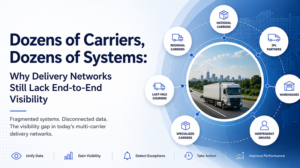
Most US auto parts distributors today operate with a mixed carrier model: a combination of in-house fleets for high-frequency local routes, national carriers for long-haul and inter-terminal legs, regional carriers for specific geographic coverage, and increasingly, on-demand capacity for surge periods or emergency replenishment. Each of those carrier types reports differently. Each uses different systems, different status update protocols, and different levels of real-time data fidelity.
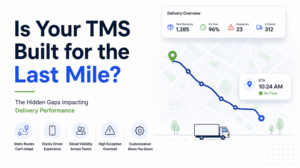
Managing complex, multi-route, multi-leg shipments efficiently across this kind of network — while reducing delays and ensuring timely deliveries — requires a platform that can compile data from many sources into a single 360-degree view of shipments, fleet movements, and delivery status. Most TMS platforms were not designed for that environment. They were built to manage a single carrier type or a single leg of the journey — not the full operational complexity of a multi-carrier, multi-terminal auto parts network.
The gap between what legacy systems can see and what is actually happening in the network is exactly where blind spots live. And as networks grow more complex, that gap widens.
What Multi-Carrier Orchestration Actually Means
Multi-carrier orchestration is the operational model — and the technology architecture — that closes that gap. It is not a visibility dashboard bolted onto an existing TMS. It is a foundational shift in how a distributor’s delivery network is managed: from carrier-by-carrier monitoring to unified, real-time orchestration across every carrier, terminal, and delivery leg simultaneously.
In practical terms, a multi-carrier orchestration platform does four things that fragmented carrier management cannot:
1. Unified real-time visibility
Every carrier in the network — in-house fleet, national carrier, regional provider, on-demand driver — pushes status data into a single operational view. Exceptions surface automatically, before a dealer calls. Operations teams see the full network state at any moment without toggling between systems or waiting for carrier check-ins.
2. Automated cross-dock coordination
Cross-dock and multi-terminal operations are optimised by ensuring seamless coordination between distribution hubs, terminals, and final-mile destinations — with AI-driven load balancing and dynamic scheduling. The handoff between carriers at a cross-dock is no longer a blind spot. It is a monitored, time-stamped event that the system tracks and flags the moment it deviates from the expected window.
3. Carrier performance intelligence
With every carrier’s data consolidated in one platform, performance reporting becomes factual rather than anecdotal. On-time rates by carrier, by lane, by terminal, and by time window are available in real time — giving operations managers the data to have productive SLA conversations with carriers and make informed decisions about network composition.
4. Proactive exception resolution
When a shipment deviates from its planned route or schedule, the platform identifies the exception automatically and surfaces resolution options — rerouting to an alternate driver, reassigning to a backup carrier, notifying the dealer proactively — before the window closes. The shift from reactive firefighting to proactive management is where the measurable cost savings compound.
The Ford Benchmark — What Best-in-Class Looks Like
The clearest available benchmark for what multi-carrier orchestration delivers in a real auto parts network at scale is the Ford Motor Company Dealer Delivery Service operation.
Ford implemented the nuVizz Delivery Orchestration platform to act as the central intelligence layer for their final-mile and middle-mile delivery operations — providing a single pane of glass view across the entire parts delivery network. The operational challenge was significant: nuVizz optimises cross-dock and multi-terminal operations for auto parts carriers by ensuring seamless coordination between distribution hubs, terminals, and final-mile destinations.
The outcome was a delivery accuracy rate of 96% of parts ordered by 4:00 pm delivered to dealerships by 10:00 am the next morning — across a network handling 90 million parts annually. For a distributor where a missing part means a vehicle sitting on a service lift and a dealer absorbing labour costs for a stalled job, that accuracy rate is not a logistics metric. It is a dealer retention metric.
The platform that made that outcome possible — nuVizz’s Auto Parts Delivery Management Solution — provides a central dispatching view across multiple parts depots, with barcode scanning to ensure correct parts are delivered, real-time tracking of individual cages, and carrier performance data captured at regional distribution hubs to support performance-based carrier contracts.
The Ford result is instructive not because every auto parts distributor operates at that scale, but because the operational model it demonstrates — unified visibility, cross-dock coordination, automated exception management across a multi-carrier network — is the same model that applies to a regional distributor running 15 terminals as it does to a national operation running hundreds.
Is AI in your last mile actually delivering results — or just empty promises?
See What’s Really Working in 2026What to Look For in a Multi-Carrier Orchestration Platform
For logistics operations managers evaluating platforms to address carrier blind spots, five capabilities separate genuine orchestration platforms from visibility tools that solve only part of the problem:
1. Network architecture, not single-carrier design
The platform must be designed to handle many-to-many carrier relationships natively — not as an integration project, but as a core architectural capability. Leading platforms connect internal fleets, national carriers, regional couriers, and on-demand gig drivers into one unified dashboard — without requiring separate logins, separate reports, or separate exception queues for each carrier type.
2. Real-time event-based tracking, not batch updates
Status updates that arrive every few hours are not sufficient to manage exception windows in auto parts delivery. The platform must push real-time events — departure scans, cross-dock arrivals, delivery confirmations, exception flags — as they happen, not on a reporting cycle.
3. Cross-dock and multi-terminal management
Auto parts distribution is defined by multi-leg complexity. A platform that manages only the final mile without visibility into the cross-dockhandoffs that precede it is managing the last few minutes of a two-hour operation. Full orchestration requires visibility and control at every leg.
4. Carrier performance reporting built in
Accountability without data is not accountability. The platform should generate carrier performance reports automatically — on-time by lane, exception rate by carrier, dwell time at terminals — that operations managers can use directly without manual data assembly.
5. Scalability without platform migration
The platform needs to grow with the network. A distributor adding a new regional carrier or expanding into a new geography should be able to onboard that carrier into the platform without an IT project. Integration-agnostic architecture and API-first design are the technical signals to look for.
Conclusion: Closing the Blind Spot for Good
Carrier blind spots are not an unavoidable feature of multi-carrier logistics. They are a product of systems that were never designed to see the whole network simultaneously. And they are costing US auto parts distributors in ways that compound silently — through failed deliveries, manual exception management, eroding carrier accountability, and dealer relationships that deteriorate before anyone connects them to a visibility gap.
Multi-carrier orchestration closes that gap. Not by adding another dashboard to monitor, but by building a single operational layer across the entire network — one that sees every carrier, flags every exception, coordinates every cross-dock handoff, and gives operations teams the data to make proactive decisions rather than reactive ones.
The distributors building that capability now are not just reducing cost per delivery. They are building the operational infrastructure that dealer retention, competitive differentiation, and network growth depend on.
Book a demo with nuVizz → See multi-carrier orchestration built specifically for auto parts distributors.


FAQs:
A carrier blind spot is any gap in real-time visibility between the point a shipment leaves your facility and confirmed delivery — most commonly at cross-dock handoffs and between disconnected carrier systems. In US auto parts distribution, blind spots cause missed delivery windows and dealer dissatisfaction before operations teams even know a failure is forming. They are the single most expensive visibility gap most distributors are not actively measuring.
Unmanaged carrier visibility gaps consistently represent 8 to 12% of total logistics operational costs for US multi-carrier networks. Costs accumulate across failed first-attempt deliveries, manual exception labour, and emergency re-runs — none of which appear as a single line item. The harder-to-measure cost is dealer relationship erosion, which is typically higher in long-term revenue impact.
Multi-carrier orchestration unifies in-house fleets, national carriers, regional providers, and on-demand capacity into one real-time platform for dispatch, tracking, and exception management. Unlike traditional TMS platforms, it consolidates every delivery leg and cross-dock handoff into a single operational view. The result is proactive exception resolution — not reactive firefighting after a dealer calls.
Auto parts distribution runs on next-morning delivery windows — a single missed cross-dock handoff can halt a vehicle on a dealer service lift. Without real-time visibility, the first alert is a dealer phone call, by which point recovery options are limited and costly. Real-time carrier visibility allows operations teams to intercept exceptions before the delivery window closes.
For US auto parts distributors managing multi-terminal, multi-carrier networks, nuVizz is the leading purpose-built platform — recognised in the 2025 Gartner Market Guide for Last-Mile Delivery Technology. nuVizz has been deployed at scale for Ford Motor Company, delivering 96% next-morning delivery accuracy across 90 million annual parts shipments. No other last-mile TMS matches its combination of cross-dock coordination, AI dispatch, and automotive-specific network architecture.
AI delivers three measurable improvements in auto parts last-mile operations — dynamic route optimisation, automated dispatch, and predictive exception management. Together these capabilities consistently reduce driven miles by 15 to 30% and lift first-attempt delivery success rates across US multi-carrier networks. The shift from static overnight routing to live AI-driven orchestration is where the largest cost savings are captured.