Blog
The Zero-Silo Standard: Why Integrated Delivery Tracking Software is the Future of Final-Mile Logistics
Table of Contents
For decades, the final mile of delivery has been treated as a “black box” in the supply chain. Once a vehicle leaves the distribution center, data visibility often vanishes, only to reappear once the delivery is completed—or failed. This lack of transparency, often referred to as the Dark Mile, is the direct result of siloed logistics data.
In today’s e-commerce-driven economy, the “Dark Mile” is no longer just an operational nuisance; it is a financial drain. With the rise of the Zero-Silo Standard, industry leaders like nuVizz are redefining what it means to have true end-to-end visibility. This article explores why integrated delivery tracking is not just a trend, but the essential future of final-mile logistics.
What is the Zero-Silo Standard?
The Zero-Silo Standard is a logistics framework where data flows seamlessly across every stakeholder—shippers, carriers, dispatchers, drivers, and customers—without interruption. Instead of checking five different portals for one delivery status, all information is centralized in a single Last Mile TMS (Transportation Management System).
The Hidden Costs of Data Silos in Final-Mile Logistics
Before we look at the solution, we must quantify the problem. When delivery tracking software is not integrated with your WMS, ERP, and carrier network, the cost manifests in three primary ways:
A. The WISMO Epidemic (Where Is My Order?)
Customer service centers are frequently overwhelmed by WISMO inquiries. When tracking data is siloed, support agents must manually call carriers or toggle between legacy systems to find an update.
- The Math: Every WISMO call costs a company between $5.00 and $12.00 in labor. By integrating tracking data into a customer-facing portal via nuVizz, businesses have reported up to a 40% reduction in support tickets.
B. High Rate of Refusal and Failed Deliveries
When a customer doesn’t know exactly when their order is arriving, they aren’t there to sign for it. Siloed systems provide vague “day of” windows. Integrated systems provide real-time, live-map tracking.
- The Impact: Failed deliveries can cost $15.00 to $75.00 per attempt depending on the cargo. A Zero-Silo approach increases first-attempt success rates by ensuring the customer is home and ready.
C. Inefficient Resource Allocation
Without integrated tracking, dispatchers cannot see vehicle location in real-time alongside warehouse capacity. This lead to “idle minutes” and wasted fuel.
Still relying on traditional systems with hidden efficiency gaps?
Compare ROIThe Pillars of an Integrated Delivery Tracking Ecosystem
To be truly “Zero-Silo,” a platform must move beyond basic GPS. The nuVizz Last Mile TMS exemplifies this by focusing on four foundational pillars:
Pillar 1: Carrier & 3PL Orchestration
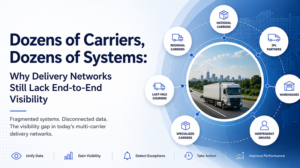
Modern logistics rarely uses just one fleet. Most enterprises use a mix of private fleets, 3PL partners, and independent contractors.
- The Solution: An integrated platform must be carrier-agnostic. It should pull API data from 3PLs and telematics from private vans into one “Single Source of Truth.”
Pillar 2: Cross-Dock and Hub Visibility
The final mile doesn’t always start at the warehouse. It often involves cross-docks, local hubs, or pharmacy labs.
- The nuVizz Advantage: nuVizz provides Cross-Dock Network Visibility, allowing managers to track movements between touchpoints, reducing dwell time and handling costs before the package even hits the final truck.
Pillar 3: Electronic Proof of Delivery (ePOD)
Integrated tracking must include the “Close of the Loop.” This includes:
- Geo-stamped Photo Evidence: Proving the item was left at the correct door.
- Real-time Signature Capture: Feeding directly into the billing system.
- Digital Chain of Custody: Especially critical for high-value items or healthcare logistics.
Pillar 4: Real-Time Event Exchange
Integrated tracking means Event-Based Information Exchange. If a driver marks a package as “Damaged on Arrival,” that event should immediately trigger a replacement order in the ERP and a refund notification in the CRM.
Why AI and Machine Learning are the Engines of Integration
A key reason nuVizz was recognized in the 2025 Gartner® Market Guide for Vehicle Routing and Scheduling is its use of AI and ML to interpret tracking data.
Integrated tracking isn’t just about showing a dot on a map; it’s about Predictive Visibility.
● Hyper-Accurate ETAs
By analyzing historical data on parking times, traffic, and even “detention times” at specific delivery sites, the nuVizz AI provides ETAs that are far more accurate than standard Google Maps calculations.
● Vizzard AI Assistant
New tools like nuVizz’s “Vizzard” help dispatchers select the best algorithms for real-time changes, turning tracking data into active route adjustments.
Stop managing by “firefighting” and start seeing risks before they disrupt your deliveries. Uncover My Supply Chain RisksSustainability: The Green ROI of Integrated Systems
For the modern enterprise, “Zero-Silo” also means “Zero-Waste.” Integrated tracking is the most direct path to reducing a fleet’s carbon footprint.
● Route Compression
By seeing the entire network, the software can combine routes and eliminate “deadhead” miles (empty miles).
● EV Monitoring
For fleets utilizing Electric Vehicles, integrated tracking is a necessity to monitor battery range and charging schedules against the delivery manifest.
● Paperless Operations
Moving to an integrated digital ePOD system saves millions of pages of paper annually, contributing directly to Corporate Social Responsibility (CSR) goals.
The Industry-Specific Impact of Zero-Silo Tracking
Integrated visibility looks different depending on the vertical. nuVizz has pioneered solutions for:
● Healthcare & Lab Logistics
Ensuring “Chain of Custody” for sensitive medical samples with 24/7 visibility.
● Retail & DSD (Direct Store Delivery)
Synchronizing hub transfers with powerful AI-based algorithms.
● Auto Parts & OEM Distribution
Managing entire distribution networks on a single platform to ensure SLA compliance.
Strategic Advice: How to Implement the Zero-Silo Standard
Moving from legacy silos to an integrated TMS like nuVizz requires a structured approach:
1. Audit Your Blind Spots
Identify where delivery data currently “disappears.”
2. Select an Integration-Agnostic Platform
Ensure your software can talk to your existing ERP (SAP, Oracle, etc.) and WMS.
3. Prioritize the Customer Experience
Choose a tool that offers white-labeled tracking pages to keep your brand front and center.
Conclusion: The Final Mile is a Data Problem
The future of logistics belongs to those who can see their entire network clearly. By adopting the Zero-Silo Standard and leveraging an integrated platform like nuVizz, businesses turn the “Dark Mile” into their greatest competitive advantage. In the world of final-mile logistics, visibility isn’t just a feature—it’s the future.
FAQs
Integrated tracking combines real-time GPS data with order details, vehicle constraints, and customer time windows. While GPS shows location, integrated tracking provides context and predictability, which are essential for business operations.
nuVizz acts as an orchestration layer, pulling data from various carrier portals into one dashboard. This allows shippers to maintain a consistent customer experience regardless of which carrier is actually delivering the package.
Companies typically see ROI through a 15-20% reduction in mileage, a 40% drop in WISMO calls, and significant labor savings via automated billing and settlement.
Yes. nuVizz has been recognized as a Representative Vendor in the 2024 and 2025 Gartner® Market Guides for Last-Mile Delivery Technology and Vehicle Routing and Scheduling, respectively.