Blog
The Neural Network of the Last Mile: How AI Route Optimization Outperforms Traditional Algorithms
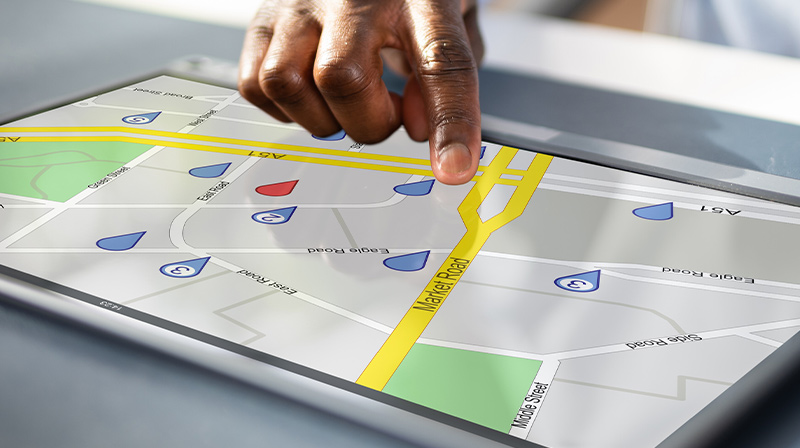
Table of Contents
The “last mile” of delivery has always been the most expensive and complex link in the supply chain. For decades, logistics managers relied on traditional algorithms—rigid mathematical models that worked well on paper but failed in the chaotic reality of city traffic.
Today, we are witnessing a shift from these linear models to what we call the “Neural Network of the Last Mile.” Just as a brain rewires itself based on new experiences, modern Last Mile Delivery Software uses Artificial Intelligence (AI) to learn, adapt, and optimize in real-time.
Here is how AI-driven optimization outperforms the old guard and why your fleet needs a “nervous system,” not just a map.
The Problem with Traditional Algorithms (The “Old Brain”)
Traditional route planning (often based on the Dijkstra algorithm or Clarke-Wright savings method) treats delivery routes like a fixed math problem.
● It assumes static conditions
It calculates a route at 6:00 AM assuming traffic at 2:00 PM will be predictable.
● It lacks memory
If a specific loading dock always causes a 15-minute delay, traditional software won’t “remember” this for next time.
● It is reactive, not proactive
It only fixes a problem after it has happened.
The AI Advantage: A Learning “Neural Network”
AI Route Optimization, like the technology powering nuVizz, operates differently. It functions as a neural network—an interconnected system that processes vast amounts of data to make intelligent decisions.
1. Dynamic Adaptation (The “Reflexes”)
A neural network reacts instantly to stimuli. Similarly, AI routing handles dynamic routing. If a sudden traffic accident blocks Main Street, the AI instantly re-optimizes the schedules of every driver in the vicinity, not just the one trapped in traffic. It balances the load across the entire fleet network in milliseconds.
2. Predictive Analytics (The “Foresight”)
Traditional models look at current distance. AI looks at future time.
- Historical Data: The system learns that “Driver A delivers 20% faster in Sector B” or “Traffic spikes on 5th Avenue every Thursday at 3 PM.”
- Weather Integration: It predicts how rain will slow down average road speeds and adjusts ETAs accordingly.
3. Continuous Learning (The “Memory”)
This is where the “Neural Network” analogy shines. Every delivery made feeds data back into the system. If a specific drop-off location has a difficult entry point that adds 5 minutes to service time, the AI learns this. The next time it plans a route to that location, it automatically buffers that extra time.
Is your tech stack ready for 2026? See why disjointed systems are costing you growth.
Read the Integration GuideAI vs. Traditional Algorithms
For quick reference, here is how the two approaches compare across critical logistics metrics.
| Feature | Traditional Algorithms | AI Route Optimization (Neural Network) |
| Data Source | Static maps & manual constraints | Real-time traffic, weather, & historical data |
| Flexibility | Rigid (routes set at start of day) | Dynamic (routes adjust in real-time) |
| Dispatching | Manual or semi-automated | Automated (RoboDispatch) |
| ETA Accuracy | Often inaccurate (estimates based on distance) | Highly accurate (predictive based on conditions) |
| Cost Efficiency | Lowers mileage (linear) | Lowers Total Cost to Serve (holistic) |
Real-World Impact: The nuVizz Approach
In Last Mile TMS, we have seen firsthand how integrating a robust AI solution changes operations. By leveraging nuVizz’s AI-driven platform, fleets move from “reacting to chaos” to “orchestrating flow.”
● RoboDispatch
AI can automatically assign on-demand orders to the best-suited driver without human intervention, reducing dispatch overhead.
● Network-Wide Visibility
Just as a brain knows what the hands and feet are doing, AI provides a single pane of glass to see every asset in your network—from long-haul trucks to final-mile scooters.
● Customer Experience
With higher precision comes better communication. AI allows for tight delivery windows and proactive customer alerts, reducing “Where is my order?” (WISMO) calls.
Conclusion
The supply chain is no longer a linear chain; it is a complex, living organism. Treating it that way requires technology that thinks, learns, and adapts.
Traditional algorithms were sufficient for the logistics of yesterday. But to survive the speed and complexity of modern commerce, your last mile needs a brain. It needs the neural network of AI optimization.
Ready to upgrade your fleet’s nervous system? Check out how nuVizz is pioneering the future of delivery management with AI that works for you.
FAQs:
AI reduces costs by cutting fuel consumption through more efficient paths, minimizing vehicle wear and tear, and reducing failed delivery attempts by providing customers with accurate ETAs.
Yes. Unlike static tools, AI dynamic routing instantly reshuffles the remaining stops to fill the gap, ensuring no time or fuel is wasted.
Modern platforms like nuVizz are designed to integrate seamlessly with existing ERPs and WMS, acting as the intelligent layer on top of your current data.